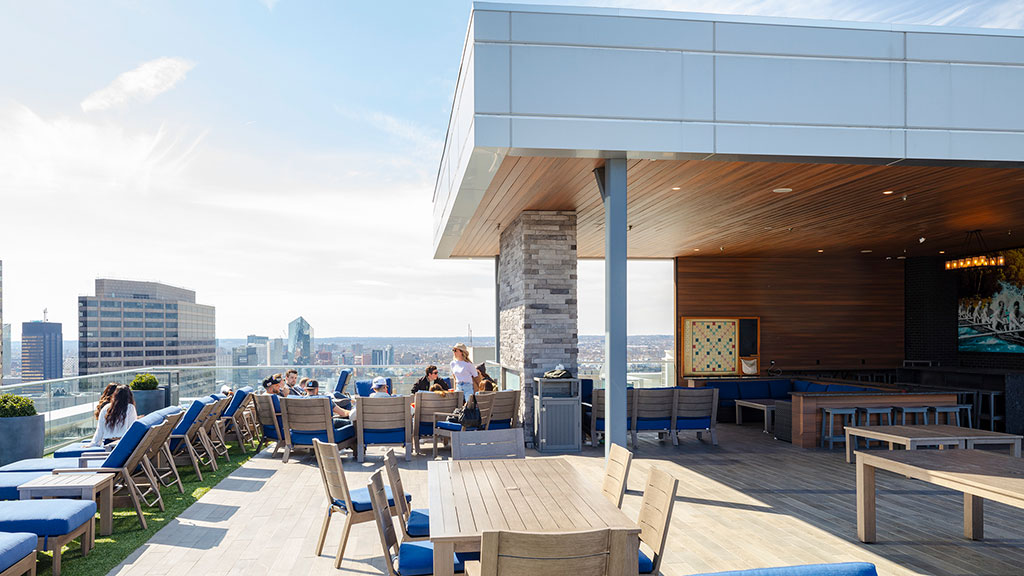
The Trends Defining What’s Next for Stranded Assets and Building Transformation
January 03, 2023
Editor’s Note: This blog is part of our Design Forecast blog series, looking at what’s next in 2023 and beyond.
Building owners and developers are facing the challenge of what to do with stranded assets: Class B and C office buildings that sit vacant as tenants flock to more modern, amenity-rich properties. While some older buildings can be renovated to increase their appeal, others can be reimagined and leveraged for conversion to first-class residential buildings.
We sat down with Gensler’s Repositioning & Landlord Services Leader Sheryl Schulze, Darrel Fullbright, Office Buildings – Developer leader, and Steven Paynter, a studio director and Design Resilience leader in Gensler’s Toronto office who is leading the efforts to convert office buildings to residential apartments, to discuss what’s next for building conversions.
We’ve heard a lot about the conversion of under-performing or “stranded” assets into other uses, such as residential, industrial, or mixed-use buildings. What’s driving this trend?
Steven: We’ve been looking at this challenge of what to do with building conversions for over two years now. A lot of that started with our clients. They came to us and said, “tell us what to do with buildings that were struggling before and are going to struggle even more post-COVID.” And this was early in the pandemic, in April 2020.
Vacancy rates have been steadily climbing over last 10 years, and this has become even more pronounced since COVID, especially in the Class B and C market, where leases similar are not getting renewed. We’re seeing a lot of these assets being taken back — either by buildings being repossessed or through liquidation as distressed assets. This opens opportunities for new investors and developers. We’re also working with a lot of our clients to diversify their holdings from primary office to a more mixed portfolio — more residential, more industrial — not because it would be more profitable but certainly because it would be less risky. And you’re starting to see that through conversions, or through some of the big players selling their assets and reinvesting that money into different types of buildings.
When you look at vacancy rates, and the average for cities, it doesn’t really tell the whole picture. That’s why we’re focused on the lower class of buildings, the older assets that are 40-50 years old that need a stronger repositioning approach.
The pandemic also really hurt downtown businesses, retailers, service providers, and restaurants. It reduced tax revenue and increased issues around homelessness and crime. Bringing people back can help solve those problems. If they’re not coming back to the office five days a week, then we need people living there, we need to diversify the use of downtowns to make them more lively, 24/7, and vibrant. That is why we worked with the City of Calgary in 2020 to study their downtown core and it’s why we’re now working directly with over a dozen U.S. cities to look at a citywide approach to conversions.
Darrel: A catalyst to bring these central business districts back is to make them 24/hour cities and remix up these communities. One way to do that, rather than building new, is to convert outdated assets that are office buildings, usually Class B and C. Our challenge is figuring out how to do that at a community scale.
Many of our clients would like to build new but there are financing challenges. Right now, because of interest rates, rising costs, and inflation, our clients are having trouble getting deals and capital. There are a lot of economic headwinds preventing developers for developing projects from scratch. That, in itself, may force some clients to look at repositioning.
Sheryl: We’ve been following this topic of repositioning stranded assets over the past year. It’s not a new trend. Everyone’s talking about it; however, it’s not getting the traction it needs yet. The one thing we’ve seen is more building conversions. We’re seeing fewer buildings become all office — everyone is trending towards more mixed use. Our urban areas need to be more mixed-use, experiential destinations.
The majority of our clients that were solely in the office arena have diversified their portfolios greatly and continue to do so. All of our teams have been able to cross-train into these new areas — whether that’s in residential microapartments or retrofitting mixed use into what was a single-use building.
How do the “flight to quality” and “flight to experience” play into this trend?
Steven: Not only is there less leasing happening in Class C buildings, but there’s a lot more of them as well. That really illustrates the idea of “flight to quality” — people are actively moving away from lower class buildings, taking less space potentially but paying more for it in the higher-class buildings. This is a direct result of them trying to get people back to office. It’s very difficult to convince someone to commute for an hour to come into an uninspiring office building or space. That flight to quality is allowing companies to bring workers back to downtowns. To draw workers back, the office — and office buildings — must be worth the commute. Class C buildings near transit are doing ok, but once the commute gets more complex, then people simply aren’t showing up.
Darrel: Developers are looking for something that distinguishes them in the market so they can better position their projects. That’s where flight to quality comes in. Flight to quality is a lot of things — it could be about providing a more resilient or a more flexible building. The “flight to experience” is really about creating experiences that make the office an environment that’s at least as good as, if not better, than home.
Why is community integration and a diversity of uses so critical to reviving downtowns?
Darrel: In part, it’s taking the ground floor and opening it up and figuring out how to give parts of it back to the community, so you’re not creating an island but being an asset. During the pandemic, lots of buildings were sitting empty but couldn’t pivot to newly needed uses. Having that built-in flexibility can help strengthen a building’s long-term value and help revive our cities. How do we build mixed-use communities so they are not just office buildings that are dead at night but spaces that bring 24-hour life to the neighborhoods they serve?
Sheryl: For these buildings to survive in terms of revenue, they need to activate all these other components. Without community integration, our downtowns cannot survive. The retail, the lunch places, cannot survive on revenue Tuesday-Thursday. We’re going to see more shared amenities at the ground floor level — it will activate a lot of underutilized retail space and engage the community.
How can Gensler help with building conversions, and specifically office-to-residential conversions?
Steven: We’ve developed a creative process to determine how successful a conversion project would be on a given building. We’ve built an algorithm that takes any information about a building — the floorplates, the shape, location, etc. — it runs through a series of analysis and gives us a score that tells us whether the building could be good candidate for residential conversion. This office-to-residential conversion scorecard can help our clients assess their properties and get the most return on their investment.
For media inquiries, email .
