Transcending
the Transaction

GENSLER RESEARCH INSTITUTE
A person working on a computer.

The customer experience is only as strong as the service behind it. The person who greets a customer, answers a question, or solves a problem shapes the experience as much as the space or the product does. In Gensler’s 2024 U.S. Consumer Experience Survey, shoppers cited customer service as one of the top reasons for a negative in-store experience. Two-thirds said they didn’t enjoy their interactions with sales personnel and service providers. In store design, the customer journey gets most of the attention. It's time to focus on the other side of that interaction.

We surveyed 12,941 service workers across 16 countries and four sectors (retail, food and drink, hospitality and travel, and entertainment). Retail workers were the least likely to report a great experience at work. That made us curious about the ones who did. In a sector organized around transactions, an employee has the power to turn a routine purchase into the start of a relationship with the brand. We interviewed 25 retail employees in the U.S., U.K., UAE, and Mexico who love their jobs to understand what made their work meaningful and what helped them do it well.

Chapter 1
Retail employees are the least likely of all service workers to report a great experience.

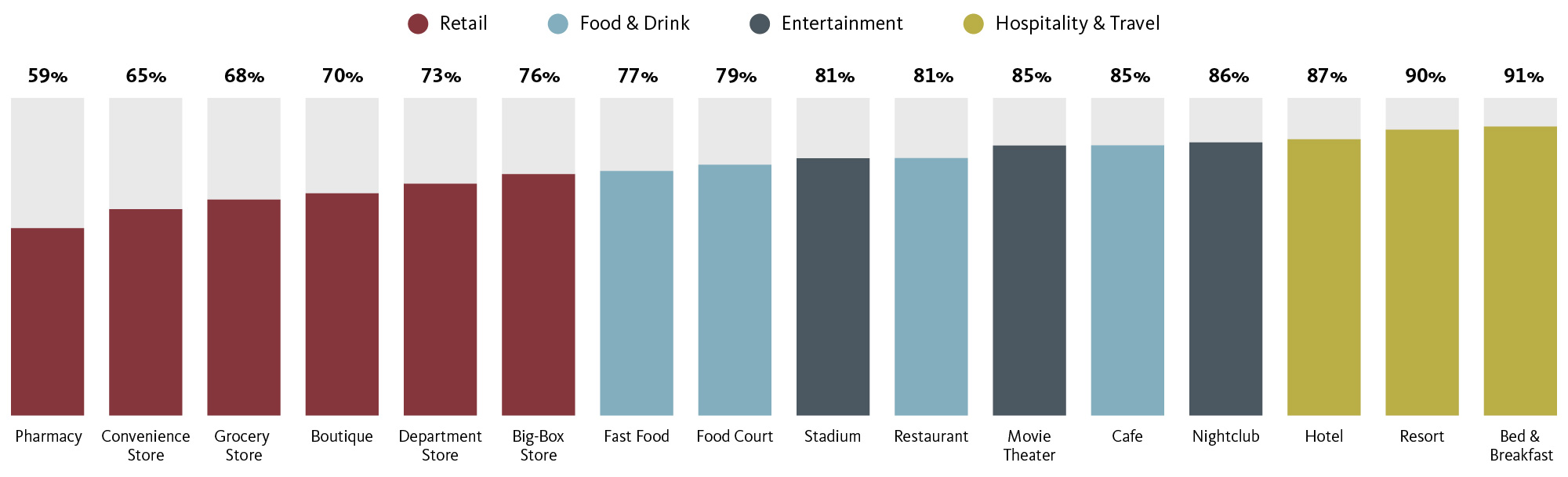
Overall, 78% of service workers said their workplace offers a great employee experience, but the average response varied across sectors and workplaces. Workers in resorts, hotels, cafés, and restaurants reported far better experiences than workers in pharmacies, convenience stores, grocery stores, and department stores. The more transactional a job, the less likely employees are to enjoy it.

The more transactional the job, the worse the workplace experience.
The percentage of respondents who agreed with the statement “The place I work offers a great experience for employees,” by service worker sector.
Chapter 2
Relationships, expertise, and autonomy make retail jobs meaningful.

The retail workers we interviewed described three connected sources of meaning. Relationships with coworkers gave employees a sense of belonging and support, while building rapport with customers made the work personally rewarding. Expertise gave them the confidence that they had something valuable and distinctive to share. Feelings of autonomy enabled them to exercise their judgment, contribute ideas, and take ownership of their work. Each of these qualities allowed retail workers to see the impact of their work firsthand, and to feel part of something larger than a transaction.

My coworkers motivate me. We have nice friendships among ourselves and also with the boss.
—Cashier, Grocery Store, Mexico
It’s so satisfying when a customer has a vision, and I can help make it come to life.
—Retail Associate, Specialty Retail, U.S.

I have the autonomy to put my own stamp on the work.
—Retail Associate, Specialty Retail, U.S.
Chapter 3
Design can create more opportunities for meaning making in retail settings.

The physical space can create the conditions for relationships, expertise, and autonomy to flourish. Shared sightlines help coworkers see when a customer or coworker needs a hand. A designated de-escalation space gives employees somewhere to invite a frustrated customer to sit down, talk, and reset, which can ease the pressure of a difficult interaction. Displaying product information close at hand helps workers put their expertise to use. Movable displays and modular furniture give retail workers more agency in adapting to reflect local sensibilities and functional needs.

I would suggest adding a sit-in sofa area where we could take a customer if they get upset.
—Customer Service Manager, Big-Box Retailer, UK
Our stockroom, which is my engine room, has to be right. If that is not right, nothing else happens.
—Store Manager, Luxury Fashion Outlet, UK

We asked the manager to [change the counter layout] — they made the change, and now the space is much better.
—Sales Advisor, Luxury Fragrance, UAE
Conclusion
Design for the people who make service human.

An employee can turn a routine purchase into a moment of connection, but doing so takes expertise, room to exercise judgment, and support. That holds well beyond the sales floor. As digital content gets easier to produce and harder to trust, a conversation with someone who knows their stuff and has a point of view can give customers a reason to believe in a brand. Let technology handle routine tasks. Design service work so people have the time and authority to do what earns customers’ trust.

 
Methodology
Gensler conducted this study in two phases in 2026. First, we surveyed 12,941 service workers across 16 countries and four sectors (retail, food and drink, hospitality and travel, and entertainment) about their experiences at work and their views on AI. We then interviewed 25 retail employees in Mexico, the United Arab Emirates, the United States, and the United Kingdom who reported positive experiences at work. The interviews explored what makes retail work meaningful in a sector often organized around transactions. We compared our findings with those from the 2026 Gensler Workplace Survey of office workers and the 2024 U.S. Consumer Experience Survey.
TRANSCENDING
THE TRANSACTION
GENSLER RESEARCH INSTITUTE
DOWNLOAD

Download Transcending the Transaction to learn more about what makes retail work meaningful and how we can better support the people doing it.