Designing Cities for Women Improves Cities for Everyone
What Gensler’s City Pulse research reveals about the female urban experience and what cities can do to improve it.
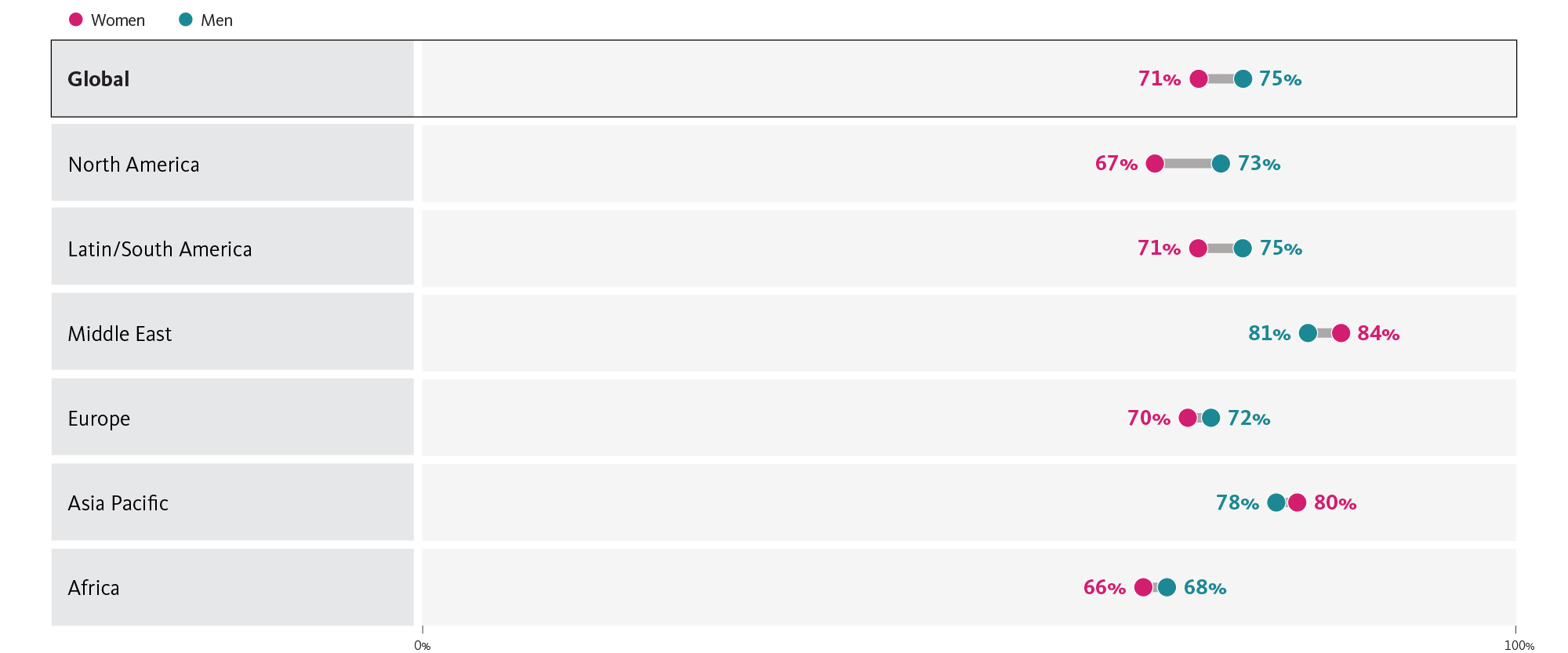
For women, navigating the city often means navigating risk. Many feel less safe in public places, on transit, or walking alone. Across global cities, women consistently report a worse experience of city life than men, with 71% overall satisfaction compared to 75% for men. But our City Pulse survey reveals these challenges are not inevitable — and can be addressed through design.
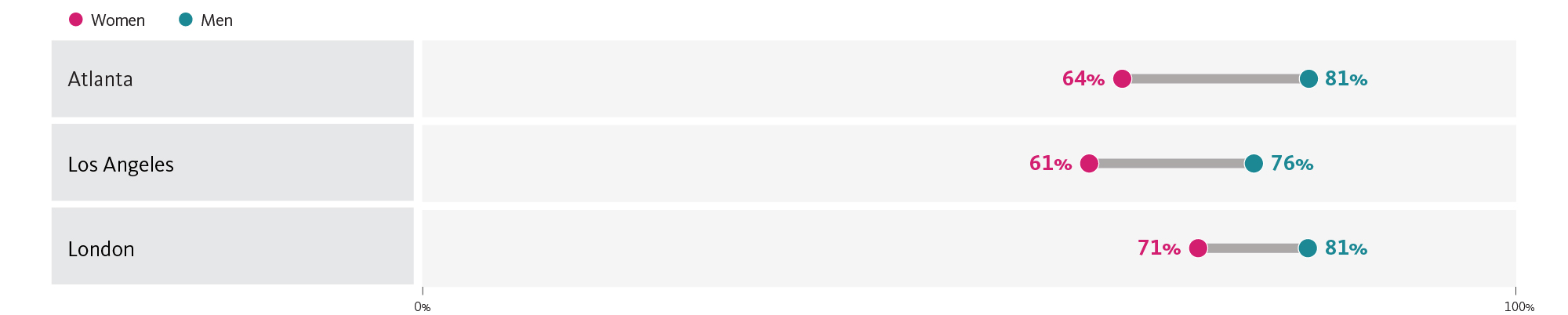
Feelings of safety and unaffordability are the primary factors driving this gap. North America shows the greatest divide, with even wider disparities in cities like Atlanta (17 percentage points) and Los Angeles (13 percentage points). Outside the U.S., London records the biggest difference at 10 percentage points.
At the same time, women in Africa, Asia Pacific, and the Middle East report satisfaction levels that are either equal to or slightly higher than men’s, suggesting that these gaps can be erased when cities get the conditions right.
A Clear Experience Gap
Safety is the Fault Line
Across regions, one factor emerged as the most consistent and consequential divide between men and women: feelings of safety.
Globally, 61% of women say they feel safe in their city, compared to 68% of men.
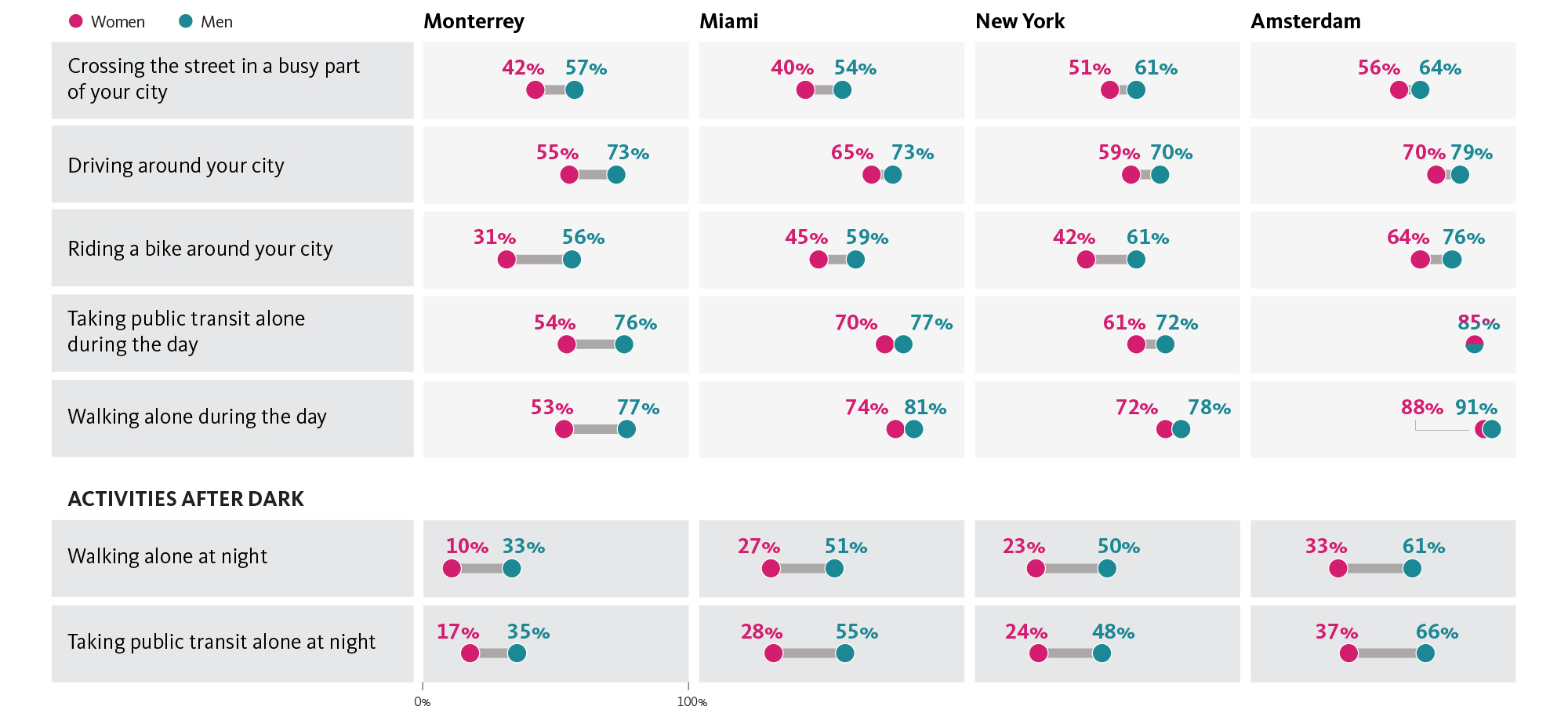
At the city scale, the gaps can be staggering. In Monterrey, Mexico, women report feeling safe at rates 19 percentage points lower than men. In both Miami and New York, the gap is 15 percentage points. In Amsterdam, women also report feeling significantly less safe than men, with a gap over 16 percentage points.
Feelings of safety are not simply a measure of crime rates. Urban security reflects lighting, visibility, cleanliness, transit reliability, and the subtle cues that signal whether a place is cared for. It reflects whether a woman feels she belongs in public space at all hours — or only at certain times.
Time of Day Changes Everything
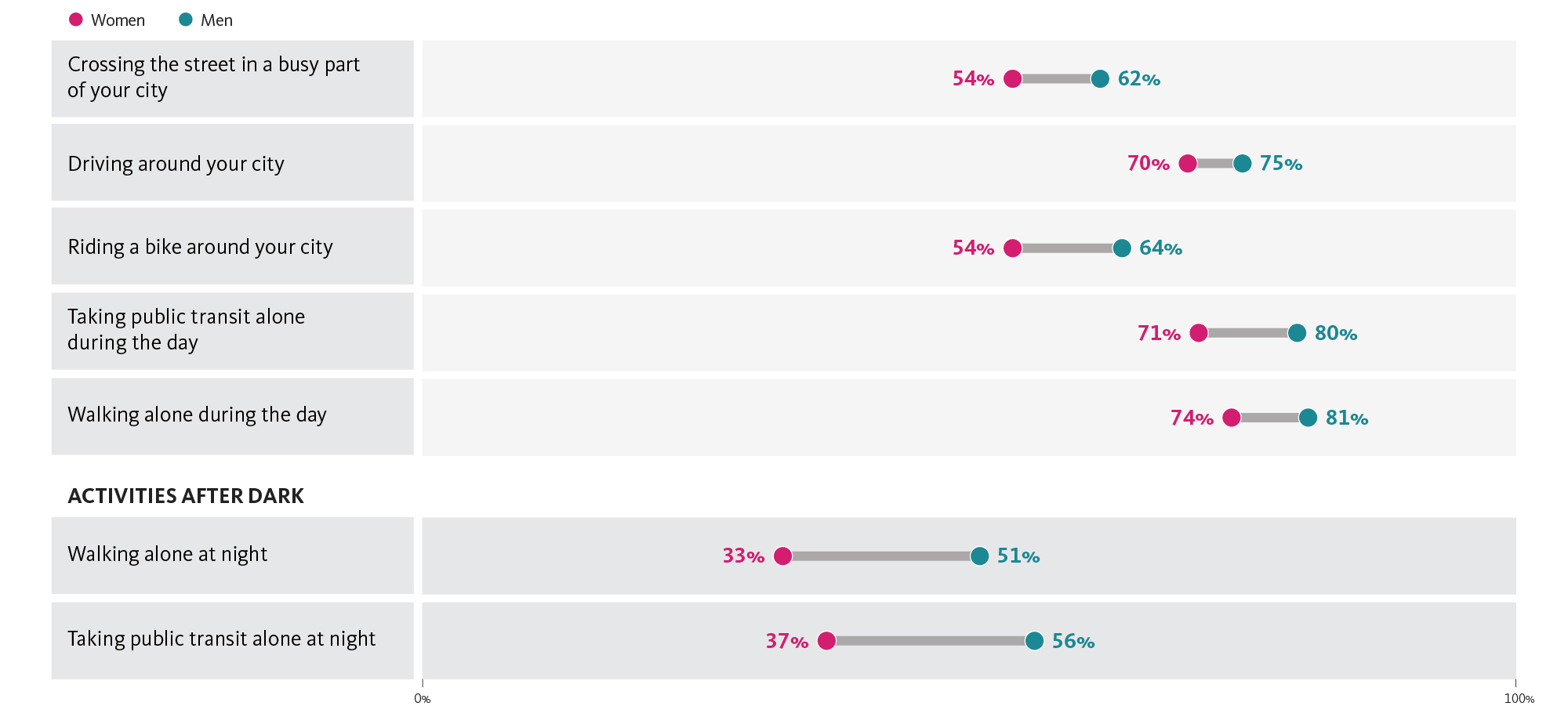
After dark, gender gaps widen.
Women consistently report lower comfort in public spaces at night, lower satisfaction with transit after peak hours, and less participation in evening activities. This matters because cities are not nine-to-five environments. Economic opportunity, cultural vibrancy, and social life increasingly operate on extended hours.
If women feel less safe taking transit at 10 p.m., less comfortable walking through a district after dinner, or less confident lingering in public spaces, they are not simply less satisfied — they’re participating less fully in urban life. And when half the population withdraws from public life, cities lose the foot traffic, spending, and social energy that make urban places worth inhabiting. The gap in women’s participation is not just an equity issue — it is a vibrancy issue.
Transit is Unequal
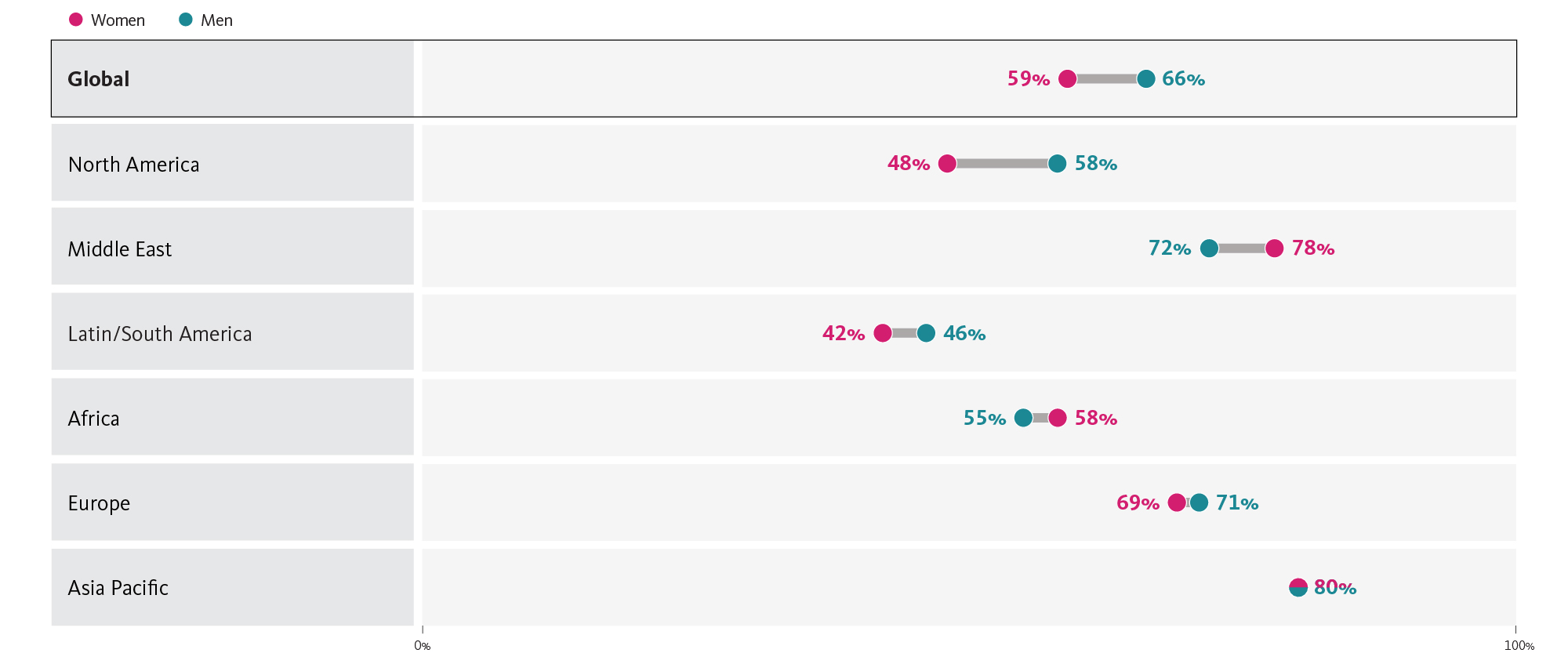
Globally, women report less satisfaction with public transit than men. In North America, that gap grows to more than nine percentage points — the largest regional divide in the dataset. In cities like Baltimore and Atlanta, the gap exceeds 16 percentage points.
Transit is not just about moving from one place to another. It is about waiting environments, platform design, lighting, staffing, frequency, and predictability. A 10-minute wait in a well-lit, active station feels fundamentally different from a 10-minute wait in a dim, empty one. Design decisions shape whether transit feels like shared infrastructure — or a risk.

Unaffordability and Optimism
The survey also reveals something subtler: Women report more economic strain and less optimism about the future of their cities.
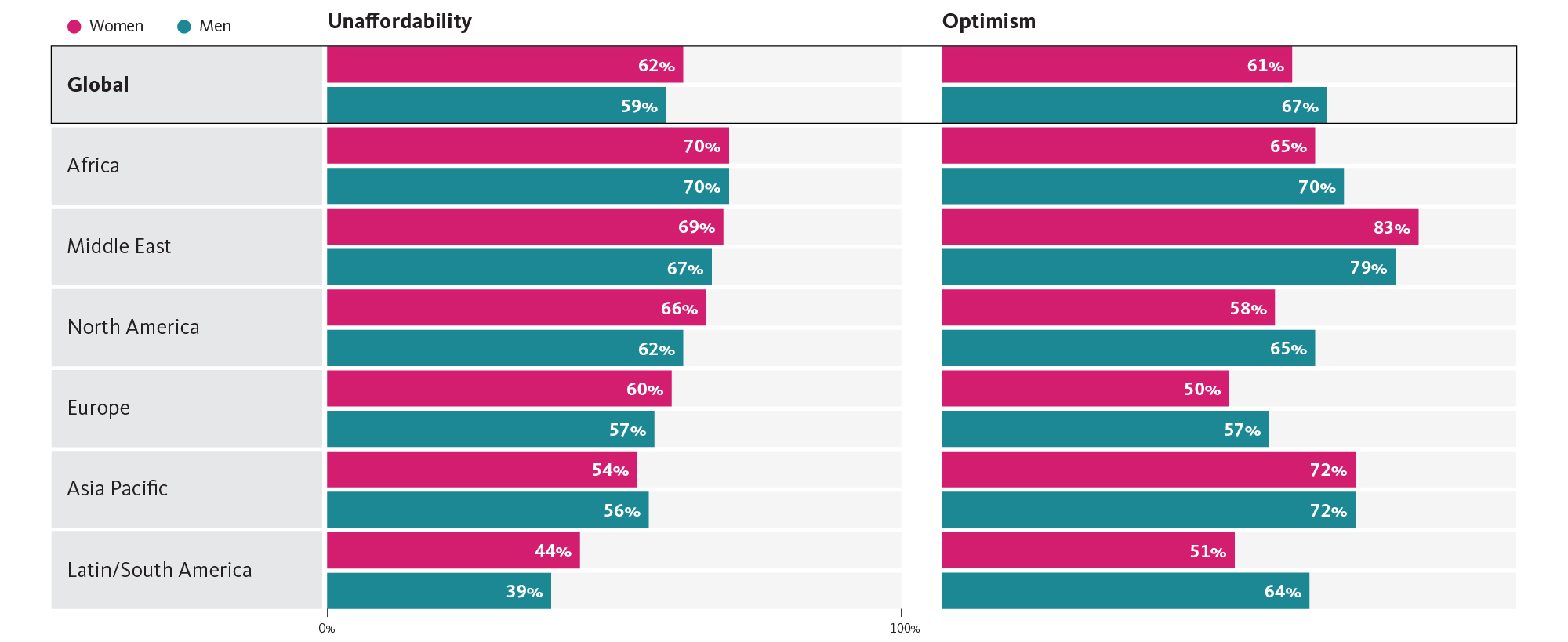
Globally, women are more likely to say their neighborhood has become less affordable over the past year. In North America and Latin/South America, that unaffordability pain is especially pronounced.
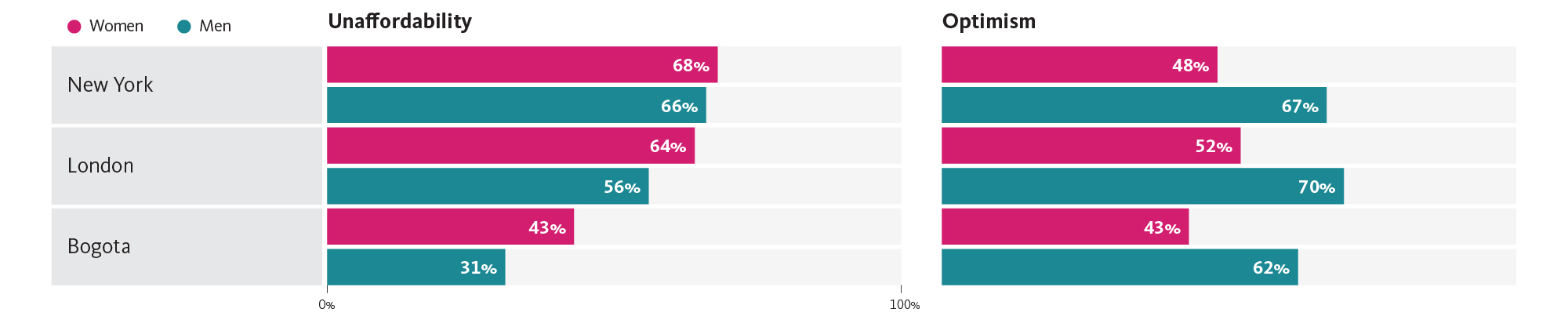
Optimism shows an even clearer divide. Worldwide, women are six percentage points less likely than men to feel positive about their city’s future. In London, Bogota, and New York City, the optimism gap exceeds 15 percentage points.
Optimism is not an abstract sentiment. It shapes whether people invest their careers, families, and long-term plans in a place. A city that does not feel safe, affordable, or accessible after dark risks losing residents, workers, visitors, and businesses.
Where Do We Go From Here?
Not every city is failing women, but most are. Where disparities do exist, they cluster around a consistent set of conditions: safety and economic strain.
These are design and policy questions. The cities where women thrive show us it doesn’t have to be this way. We can look to what these cities are doing and use them as positive examples for design in our most unequal places.
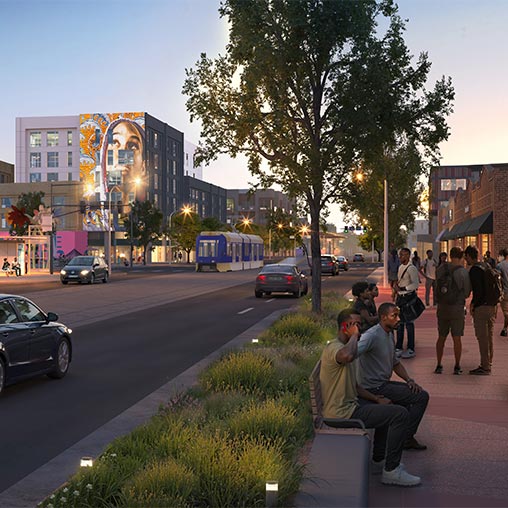
Lighting, maintenance, and active ground floors can transform perceived safety. Frequent, well-staffed transit can make people feel safer. Mixed-use districts and programming can keep streets lively at night, as well as during the day.
These interventions are not niche. They benefit everyone, not just women.
Designing cities that work better for women produces safer, more vibrant, more equitable cities overall. The infrastructure that supports women’s participation — well-lit streets, reliable transit, active public spaces — is the same infrastructure that strengthens urban life for all communities.

For media inquiries, email .