How Modular Construction Accelerates Airport Terminal Expansion
Proven offsite methods deliver projects 65% faster with less disruption to passengers and operations.
U.S. airport terminals are aging fast as passenger volumes surge and expectations soar. Many terminals are over 40 years old, yet traditional construction methods make expansion slow, costly, and highly disruptive. That’s why a growing number of industry experts are turning to modular construction — a method long used in manufacturing and now gaining momentum in aviation.
By completing the most complex work offsite and installing fully built components onsite, airports can expand capacity faster, reduce disruption, and improve schedule certainty. Modular is rapidly becoming aviation’s most strategic tool for meeting demand.
The Traditional Construction Challenge
Traditional construction processes are vulnerable to delays, costing aviation clients a precious resource: time. Traditional construction dictates that a construction project should begin and end at one work site, run on one timeline, and involve an orchestrated sequence of activities that typically starts with site clearing.
Contractors install underground utilities and building foundations, then construct the structure, enclosure walls, and roof, complete interiors, and finish with roads and landscaping. Each activity depends completely on the previous one before the next begins. Delays in this process create a domino effect, setting the completion date further behind.
Hiring and clearing a crew to work on an airfield is another challenge, during which a variety of industry, state, and federal security requirements come into play. Workers must also submit to background checks and onboarding procedures for both the construction company and the airport. It’s a meticulous, time-consuming process that is not needed when the building is constructed outside the boundaries of an active airfield.
Modular construction significantly reduces the potential for timing setbacks by making a strategic shift from current construction practices.
How Modular Construction Works
Modular construction enables simultaneous builds of the project on multiple sites. While site preparation, underground utilities, and foundations are constructed at the project’s permanent location, the building itself is constructed at a different site up to one mile away, and in several completed sections.
Once contractors complete the foundations at the permanent location, they carefully move each module on massive, self-propelled module transporters. Low-riding crane vehicles then lift and position each module in its final location. Some of those sections can weigh more than 6.5 million pounds. Each sequential module is then moved to the previous module until the entire building has been assembled. Once complete, traditional construction methods are used to complete the building's interiors.
The Benefits Add Up
Modular construction increases efficiency for workers, reducing the need for redundant protocols and better use of time on the work site. Workers also use a barcode system for interior construction to properly map and assemble the modular wall systems. After the modules move into their permanent location, workers scan a barcode to access a system that shows where to find and erect each component sequentially.
This method also breaks up a long, linear process into multiple, more efficient components. This approach choreographs multiple sites and timelines toward their final goal. Additionally, it ensures that airports can maintain a normal schedule while minimizing passenger disruptions.
Time is at a premium for aviation clients, so speed-to-market has become an important KPI. Modular construction delivers projects 65% faster than the traditional construction process, allowing airports to capture revenue sooner, minimize operational disruption, and maintain a competitive advantage.
DFW: A Case Study in Innovation
While modular construction dates to the early 1600s, it arrived in the United States in the 1900s with the creation of Sears kit homes.
In 2002, Dallas Fort Worth International Airport (DFW) began moving six prefabricated building sections into place for a concourse replacement with the High-C Gates at Terminal C to create 80,000 square feet of new terminal space, a first-of-its-kind modular effort for a U.S. airport.
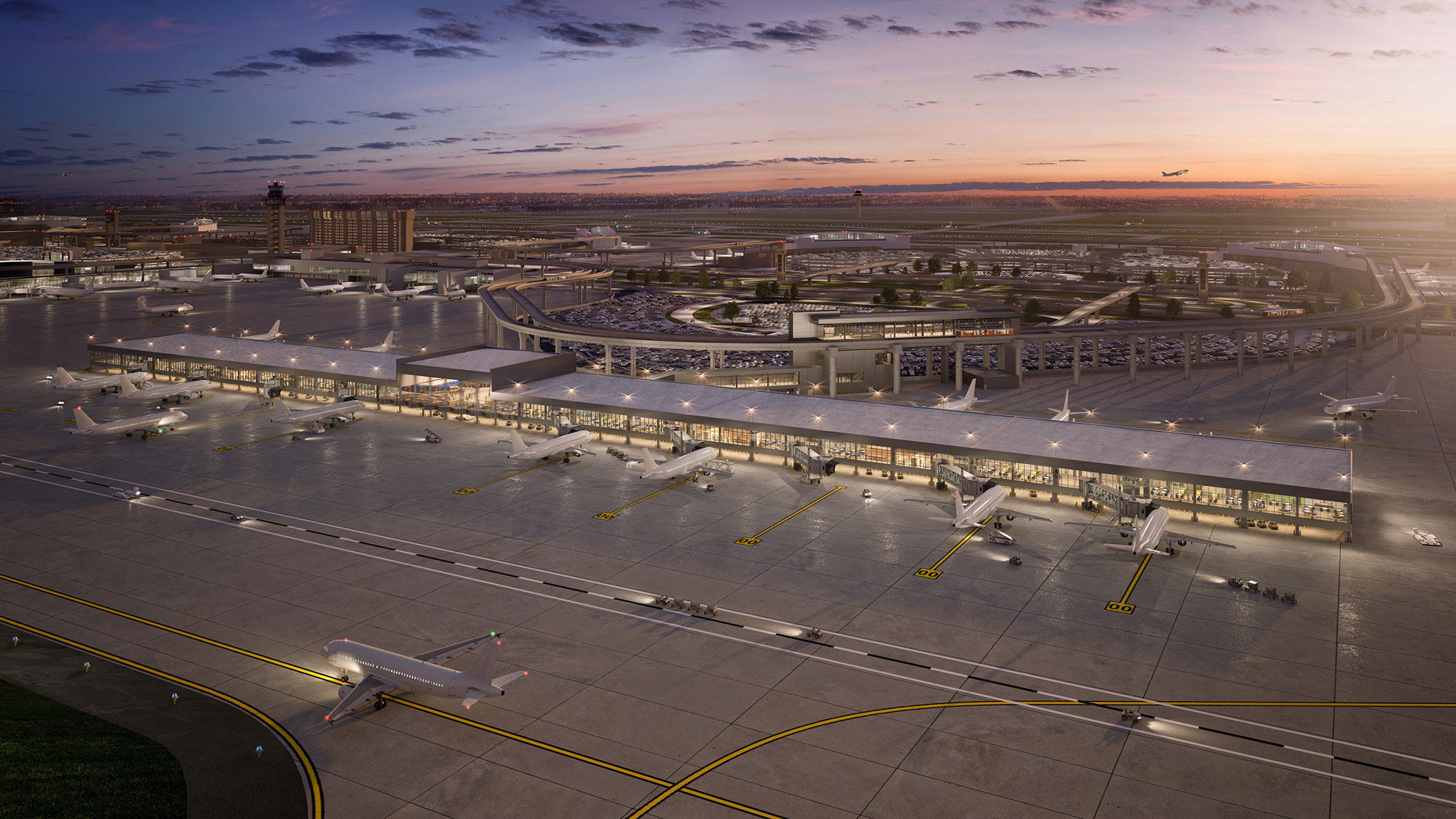
The modular process proved so successful that DFW decided to construct a new terminal using the same methods. In 2025, DFW made the largest-scale modular operation ever undertaken for an airport terminal, as workers connected sections of the new 450,000-square-foot Terminal F concourse.
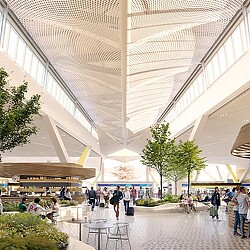
Gensler is part of an eight-member design-build consortium that is using this method to assemble Terminal F using multiple modules, each the size of a U.S. football field. By constructing the major building components off-site, the structural work can begin while sitework, demolition, and foundation work are still underway. Once complete, passengers will experience seamless interiors with no indication of the building’s modular construction.
As modular methods advance, airports can move increasingly large building sections. This approach also positions DFW for future expansion, allowing additional gates to be added with minimal disruption.
Airports like DFW set a new standard by using modular construction to build complex new facilities quickly while keeping operations running smoothly. For airport authorities planning expansion, the question is no longer whether to use modular, but how quickly they can adopt it to meet passenger demand.
For media inquiries, email .