Global Workplace Survey 2026

GENSLER RESEARCH INSTITUTE
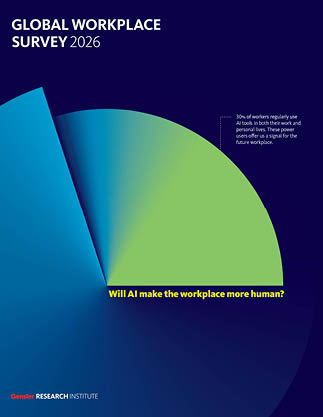
Will AI make the workplace more human?
Although AI has already started to shape how we do our work, it’s too soon to know how it’ll change to the physical workplace — but big tech shifts historically have a sizeable impact. This research explores how people work today, how the biggest users of AI reveal emerging behaviors, and how an increased focus on learning and connection is redefining the value of the workplace.
Key Finding

The office has stabilized — but there’s room for improvement.

Across the past three years of research, global work patterns have remained relatively consistent. Today, the average worker in our study today spends more than half of their time in the office, with 26% of their workweek working in non-office and non-home locations, such as coworking spaces, client/vendor sites, third places, or while traveling for business. Similarly, how people work has also remained steady — across focus time, in-person and virtual collaboration, social connection, and time spent learning.

Although how and where people work has stabilized, the workplace has not kept pace. Two-thirds report “hacking” their workspace to compensate for workspace performance gaps. One in four employees have resorted to DIY fixes for ergonomics, temperature, or visual privacy, while meeting space availability and noise remain unresolved challenges.

How and where employees work varies across country, industry, age, and role.
The percentage of time spent in each work mode in a typical workweek
The percentage of time spent working in each location during a typical workweek
Change since 2025: ▲ Increase ▼ Decrease
Key Finding
AI is reshaping the workday.
People who regularly use AI in both their work and personal lives spend more of their workweek learning and collaborating virtually compared to those who use AI less frequently. In fact, AI Power Users spend 1.5x as much time learning than later adopters. And despite spending less time collaborating in person, AI Power Users report stronger team relationships, greater encouragement to share new ideas, and more meaningful friendships at work — pointing to new patterns of connection enabled by technology.

AI power users spend less time working alone and more time learning and socializing.

The percentage of time spent in each work mode in a typical workweek
Key Finding
Learning-oriented workers stand apart.
Learning-oriented workers exhibit distinct patterns of behavior. Those who consider learning critical to their job performance devote more time to it, are more likely to experiment with new ways of working, and are more attuned to what’s happening across the organization. Together, these findings suggest they engage with their work and teams in meaningfully different ways.

Workers who value learning the most behave differently.

Key Finding
Design elements are linked to learning.
Workers are more likely to view their workplace as effective for learning when specific design elements are present. These include design look and feel, manageable noise levels, flexible furniture, access to up-to-date technology, and spaces that support both focused work and opportunities to rest and recharge.
Space factors linked to workplace effectiveness for learning.
Space factors linked to workplace effectiveness for learning based on regression analyses controlling for role, gender, living situation, age, company size, industry, and country.
SPACE ATTRIBUTES
Design look and feel of workspace
Noise level of workspace
Ability to rearrange furniture in meeting rooms
Design look and feel of open meeting areas
Design look and feel of corridors, stairways, and hallways
EXPERIENCE ATTRIBUTES
The office environment is beautiful
The office environment is equipped with the latest technology
It’s easy to access spaces to relax/recharge/take a break
It’s easy to access spaces for focused concentration
People hope the future workplace supports wellbeing and learning.
When asked to look ahead, workers consistently prioritize wellness and access to nature in the physical workplace. Outdoor spaces, natural light, and environments that support feeling productive, creative, and inspired signal a future workplace that supports both performance and personal wellbeing. The interactive graphic below reveals the elements and amenities workers prioritized most: Choose Country, Industry, AI Use, and Learning Orientation, then click on even narrower categories below to see how the priorities shift.
In the future, I hope my physical workplace has...
The percentage of respondents who selected each option in their top 5. Ranking is based on the percentage who selected each option in their top 5.
Conclusion
A new workplace value emerges.
As AI changes how work happens, the workplace is taking on a new role. If we continue to see workers emphasize learning and social connections, the physical workplace will become a more critical investment in people. Spaces that support wellbeing, learning, and collaboration help organizations attract talent, strengthen teams, and enable employees to do their best work, now and into the future.
 
Methodology
The Gensler Research Institute conducted an anonymous, panel-based survey of 16,459 full-time office workers across 16 countries between July 22 and September 12, 2025. The survey was deployed using a third-party panel provider. At the time of data collection, all respondents were required to be full-time workers at an organization with at least 100+ employees, within 10 designated industries. Respondents were also required to work in an office environment at least some of the time. Respondents represent a broad cross-section of demographics, including job role, company size, age, living situation, and geographical location across five global regions.
GLOBAL WORKPLACE SURVEY 2026
GENSLER RESEARCH INSTITUTE
DOWNLOAD

Download Gensler’s Global Workplace Survey 2026 to learn about the hacks that workers are using to improve their workspaces, the shifts that may come with wider AI adoption, and workers’ hopes for the future.