Will AI Make the Workplace More Human?
Gensler’s Global Workplace Survey 2026 reveals how AI is making the physical workplace more essential — not less.
Note: This is the first blog of a series unpacking the detailed findings of Gensler’s Global Workplace Survey 2026.
The rise of AI has fueled bold predictions about how work might change — from tech-automated workplaces to entirely new ways of organizing teams. But the truth is more nuanced and far more interesting. Insights from our Global Workplace Survey 2026 point to a future where AI may amplify the very things that make work human. Which raises an essential question: As AI accelerates, what role will the physical workplace play?
Each year, we survey thousands of office workers worldwide to understand how work is changing and what people need from their workplace to perform at their best. This year’s report draws on insights from more than 16,400 full-time workers across 16 countries, revealing early signals of how AI adoption may influence not only what we do but also how we connect, collaborate, and learn. And the findings may surprise you.
In an era of uncertainty, how people work and use the office is surprisingly stable.
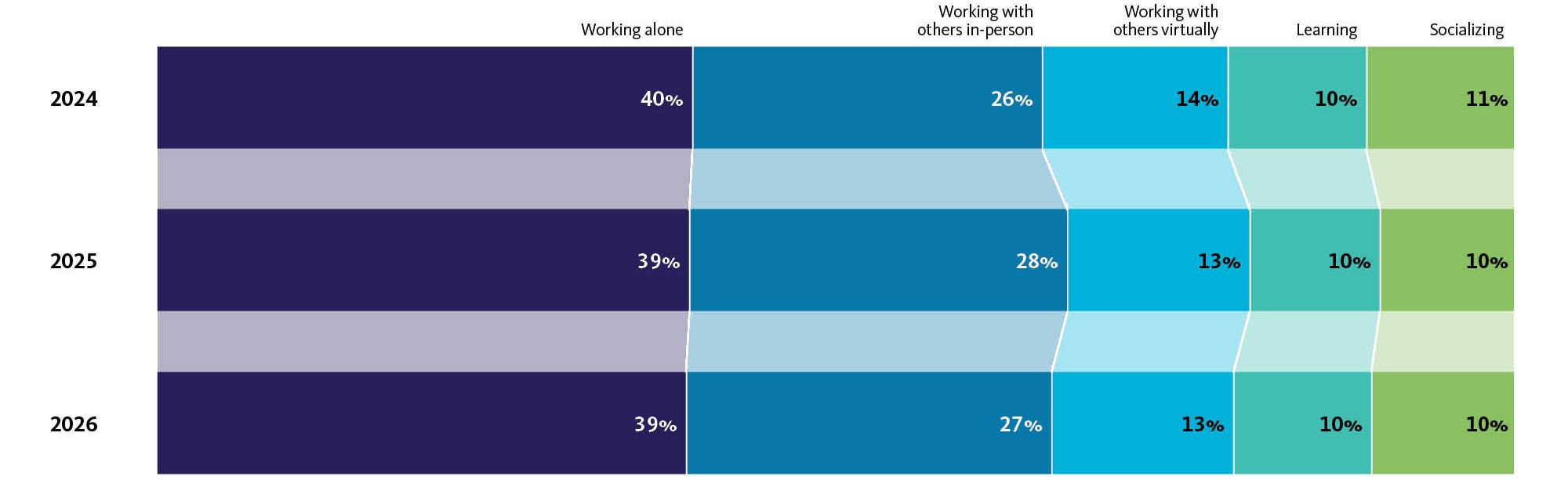
After years of RTO and experimentation, the fundamentals of how and where people work have settled into a new rhythm over the last three years. Across countries and industries, workers are spending about 40% of their week working alone, 27% collaborating in person, and 13% working virtually with colleagues — nearly identical to patterns over the last two years. Learning and social connection, which spiked after the pandemic, have remained consistent for the last three years as well.
How people work varies by country, industry, role, and age. The Government/Defense industry spends more time working alone and more time working with others in person, while Legal spends the least time working alone and, along with Media, spends the most time working with others virtually. Workers in their 50s spend the most time working alone and the least time learning and socializing. Explore all the differences in the interactive graphic.
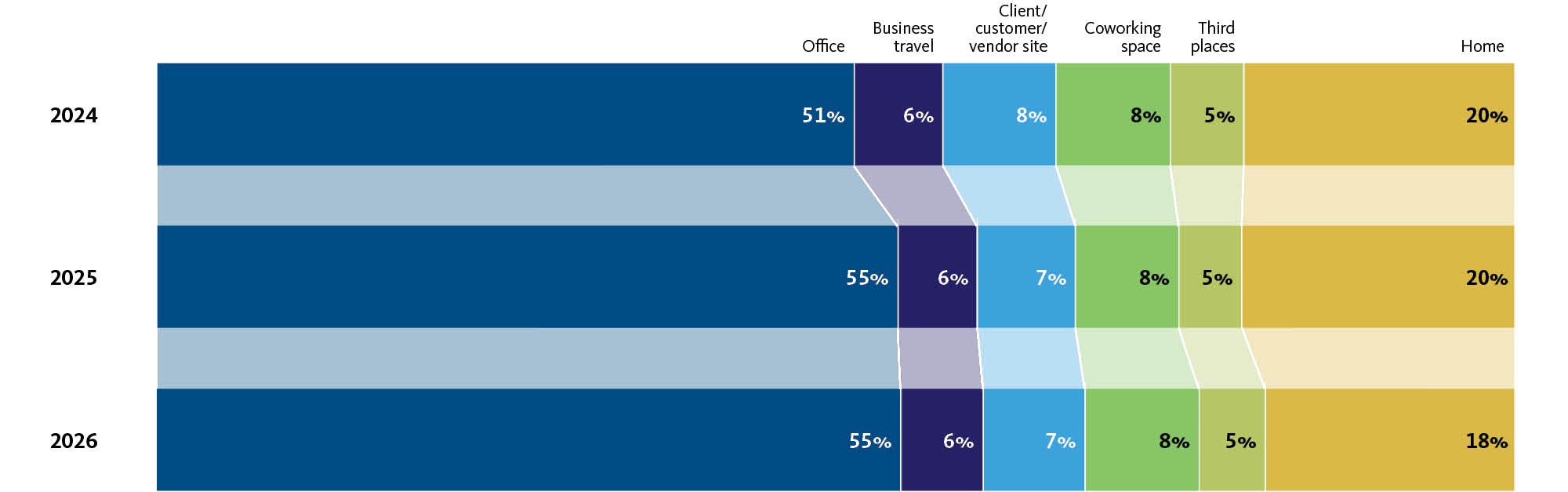
Where people work has also held steady. Globally, on average, workers continue to spend slightly more than half their workweek in the office, and 26% of their time working beyond the office, such as coworking spaces, client sites, business travel, and third places. These off-site work hours represent a larger share of their week than the 18% of time spent working at home.
Just like how people work, these percentages vary by country, industry, role, and age. Workers in Singapore and France spend more time working at the office, while those in the U.K. spend the most time working from home. Government/Defense and Consumer Goods workers spend more time in the office, Tech employees work the most from home, and Legal workers spend the most time in places beyond office and home. Role and age variations are less pronounced, except that the administrative staff spends more time in the office — a trend we’ve consistently observed. Explore our interactive graphic for more details.
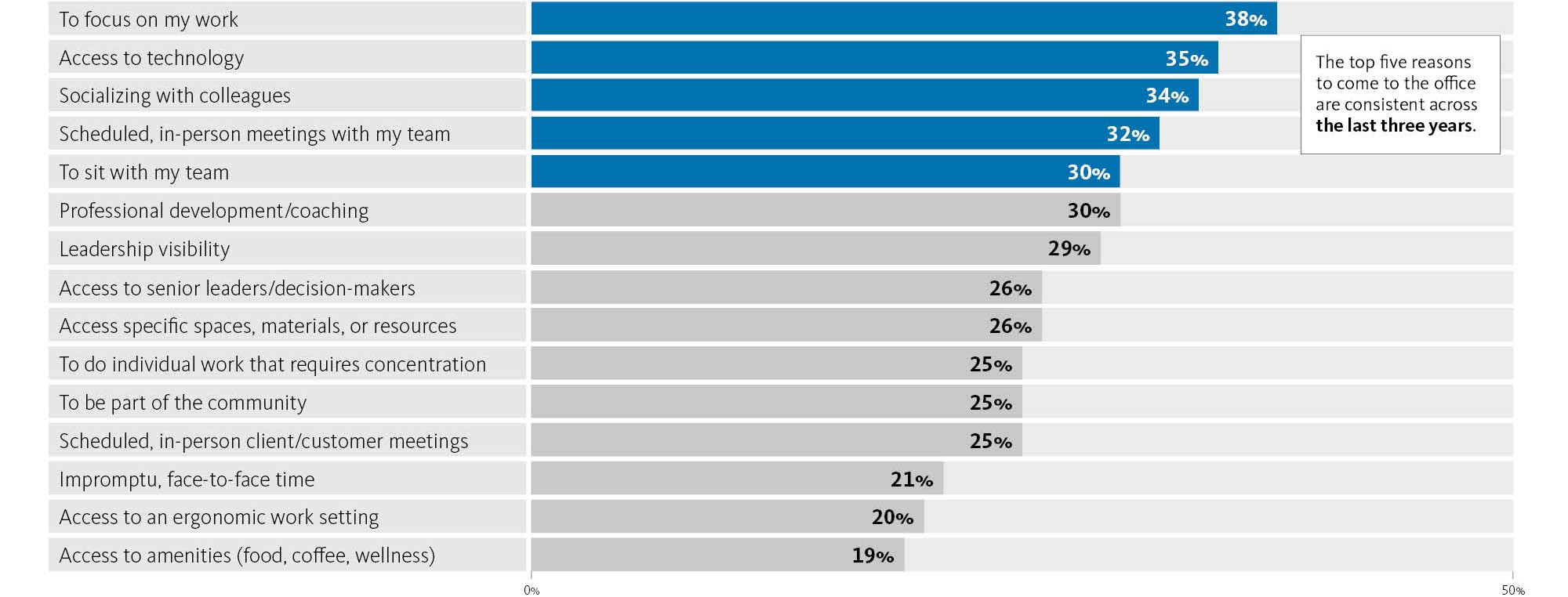
The reasons why people are coming into the office have also remained consistent. The top reason hasn’t changed since the pandemic: to get work done. In fact, the five top reasons have held steady for the last three years:
Stability doesn’t mean the workplace is effective. Challenges persist.
Even with consistent work patterns, many workplaces still struggle to meet basic functional needs. Two-thirds of global workers report hacking their workspace to improve design issues. Personalization is the most common adjustment across roles, ages, countries, and industries. Workers also report making DIY adjustments related to ergonomics or comfort, temperature, visual privacy, and storage.
Today, approximately one in six workers has unassigned seating. Workers in unassigned seating rate the office as less effective, especially for working alone and learning, compared to those in assigned seating. Over half of those in unassigned seating would prefer an assigned seat.
We can learn from these varied experiences about what works and what doesn’t. Many employees who prefer to keep their unassigned seat cite the flexibility to choose their seat each day as a reason. Many of those who have a reservation system like having the ability to reserve a seat in advance. For workers who prefer an assigned seat, many dislike the daily setup of laptops or equipment and the inability to personalize their space. They also report conflict or confusion over where people sit.

While choice and variety are at an all-time high, appropriate spaces are not always available. Many workers struggle to find available meeting rooms, leading to undesired work behaviors. Employees say they resort to taking phone calls in hallways or stairways, having meetings at individual desks, or even canceling meetings altogether when rooms aren’t available. Over one-third of employees are using meeting rooms for individual-focused work, further adding to the pressure.
Early signals: how AI may shape more human-centered patterns of work.
One of the most intriguing insights this year comes from a growing group of employees we call AI power users — workers who regularly use AI in both their personal and professional lives. Early findings suggest that AI adoption may actually push work in a more human direction.
These workers spend less time working alone and more time learning, socializing, and collaborating virtually. Far from retreating into screens, AI power users appear to be leaning into the human side of work. We often assume that more technology means less connection, but our data tells a different story. The employees most embedded in AI workflows are also the ones most engaged in learning and have better team relationships, suggesting a new value for the office in the future.
While we’ll explore this group more deeply in future blogs, these initial patterns offer an early look at how AI may change not just tasks, but team dynamics — and why the physical workplace may matter even more as AI accelerates.
Another emerging signal is the rise of the learning-oriented worker. Employees who see learning as critical to their job performance spend more time developing new skills, staying connected to team activities, and experimenting with new ways of working. Being in the office matters. Over 80% of learning-oriented employees say that working in the office positively impacts their individual productivity, team’s productivity, job satisfaction, awareness of critical intel, relationships with colleagues, and the quality of their team’s work or services.
A more human workplace in the age of AI.
What’s emerging from this year’s findings is a powerful reframing: AI isn’t just a technology shift — it’s a people shift. As AI reshapes the mechanics of work, the physical workplace matters more, not less. Companies that invest in their workplaces unlock the full potential of their people and the technology, creating places where employees come together to think, learn, and build the relationships that fuel organizational performance.
In the coming weeks, we’ll unpack what we’re learning from AI power users, dive deeper into the behaviors of learning-oriented workers, and explore what these findings signal for workplace design in the years ahead.
For media inquiries, email .