The Human Side of AI: What Power Users Are Telling Us About the Workplace
New research reveals that the employees furthest along the AI adoption curve offer a glimpse of where work is headed.
Note: This is the second blog of a series unpacking the detailed findings of Gensler’s Global Workplace Survey 2026. Read part one here.
Every new wave of technology reshapes not just how we work, but how we learn from each other. I’ve seen this pattern firsthand in my over four decades of work across workplace strategy, research, and design. So, when AI began rippling across workplaces, we wanted to understand it from the perspective of people already living it. That led us to ask: what do the employees furthest along the AI adoption curve tell us about where work is headed?
When we studied people who are further along the AI adoption curve for Gensler’s Global Workplace Survey 2026, a surprising picture emerged: These employees aren’t just using new tools; they’re working, learning, and even experiencing the workplace differently. These patterns offer a glimpse into the future — and they challenge assumptions about AI’s impact on the human side of work.
Nine out of 10 of our survey respondents say they regularly or occasionally use AI for work or personal use — a remarkably fast adoption curve for any emerging technology. To understand where this is heading, we focused on two groups at opposite ends of the spectrum: “AI power users” (the 30% of workers who regularly use AI tools in both their work and personal lives) and “late AI adopters” (the 36% who use AI rarely or not at all). The contrast between them tells a revealing story.
Who Are the AI Power Users?
The real signals that give us a glimpse into the future of work come from the AI power users. They represent every country, industry, and role in our study. They are more likely to work for global or regional companies and have stronger concentrations in technology, financial services, media, and consumer goods industries. More than half are under 40, nearly a third are managers, and they are three times more likely to perceive their organizations as among the most innovative in our sample.
How AI Power Users Learn and Connect More Often
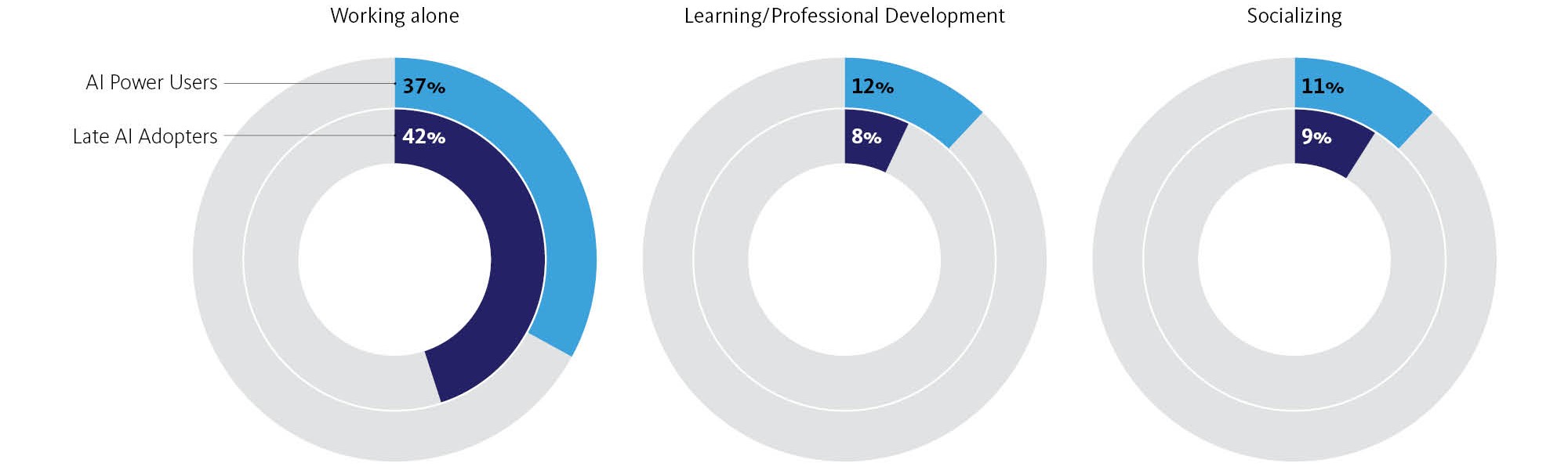
AI power users don’t spend all their time on their screens — far from it. They spend less time working alone and more time on learning/professional development and socializing, compared to late adopters during a typical workweek.
These workers are also more mobile — not just between home and office, but across a broader ecosystem of work locations. AI power users spend nearly twice as much of their typical work week working from third places, client/customer sites, coworking spaces, or while on business travel, compared to late AI adopters.
Their work behaviors tell a cohesive story: they not only learn and connect more often, but they also are more likely to learn something new, work in a variety of spaces, take time to reflect, and take time to be outdoors when they are at work, compared to late adopters. These behaviors suggest an important shift: As AI takes on more routine tasks, power users lean into activities that make work more human — learning, connecting, experimenting, and seeking inspiration in different environments.
Learning Is Highly Critical to Job Performance
AI power users don’t just spend more time learning; they view it as essential to performance. A significant majority (70%) of AI power users rate learning/professional development as highly critical to their job performance, compared to only 44% of late adopters. That’s a striking difference and a signal of how essential learning has become in an AI-enabled workplace. When you think about how fast AI is evolving, staying on top of this rapid change is a significant and ongoing challenge. There are no formal training manuals. Learning in the moment from team members and sharing tips and tricks with colleagues are often how we learn about rapidly changing technology.
And while the technology is new, the pattern is familiar. I still remember when computers first arrived in our design studios — the curiosity, the experimentation, the uncertainty, and the excitement. Every new tool and application reshaped not just our process, but how we interacted and learned from each other to reimagine the design process in new ways.
Today, AI lets designers explore design possibilities even earlier in the process than tools like CAD or BIM modeling, and it demands the same real-time, peer-to-peer learning. That kind of learning happens in the office, in impromptu hallway collisions, or during shared insights over coffee. The workplace is where trust is built, connections are formed, and new ways of working take hold.
Higher Innovation, Engagement, and Team Relationships Scores
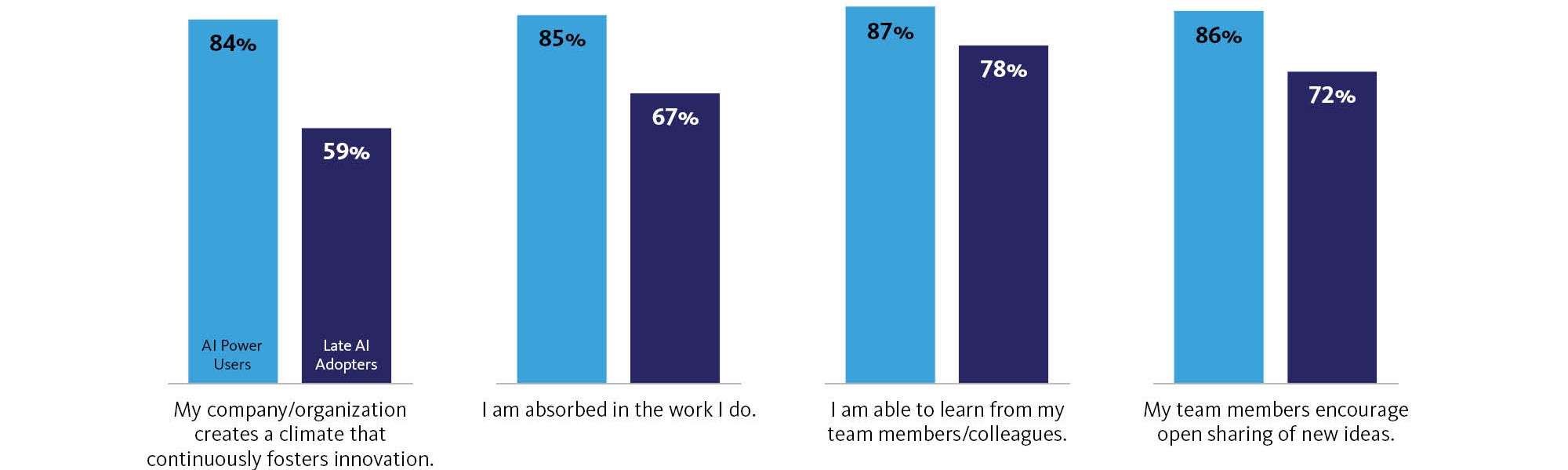
AI power users score significantly higher on innovation, engagement, and team relationships than late AI adopters. Compared to late adopters, more AI power users agreed or strongly agreed with questions about team relationships, from forming meaningful friendships at work to enjoying the company of team members or colleagues. These findings challenge fears that AI will isolate employees. Instead, AI power users appear to be leaning more on their teams, not less.
The Office Has a Bigger Impact on AI Power Users
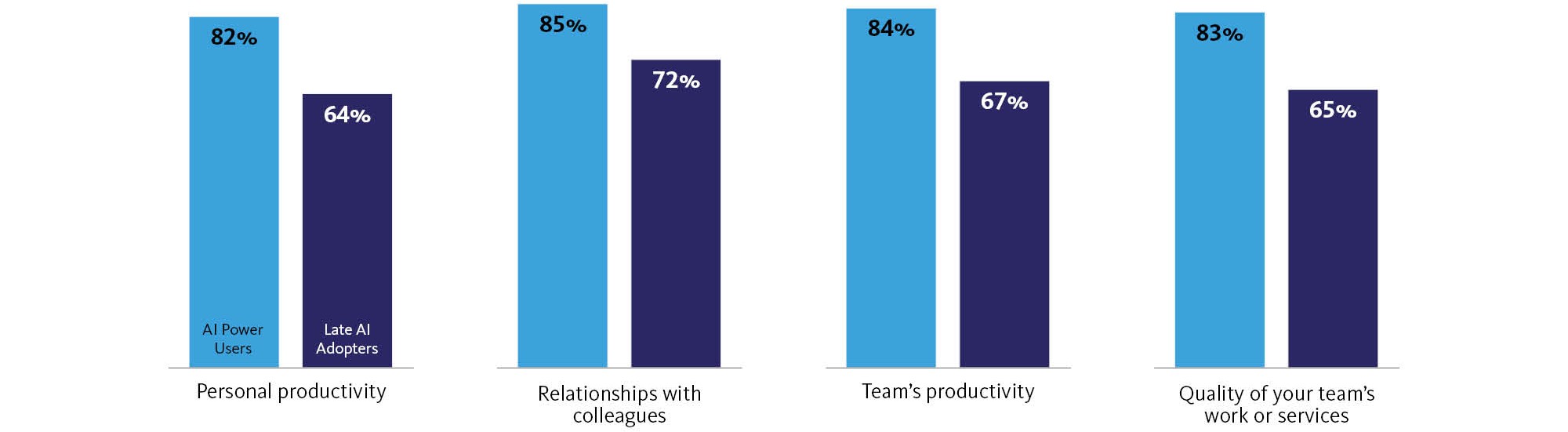
Although AI power users spend slightly less time in the office overall, being in the office has a greater positive impact for them, compared to late adopters. AI power users are more likely to say that working in the office positively or very positively impacts their personal productivity, their relationships with colleagues, their team’s productivity, and the quality of their team’s work or services.
According to our data, the most common reason to come into the office is “to focus on my work.” While AI power users reported this as the top reason for the office, they are also more likely to rank accessing technology than late adopters (40% vs 29%). For AI power users, the office doesn’t just support work; it elevates it.
A New Value for the Physical Workplace
As learning and connection become even more critical, the physical workplace takes on new importance — not as a space for focused production, but as a strategic investment in people. This requires workplaces to become both tech-forward and human-centric.
The signals from AI power users are clear: The future of work is more human, not less. Organizations that thrive in the AI era will be those that invest in workplaces designed for people to grow.
For media inquiries, email .