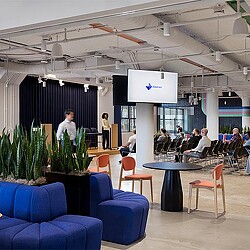
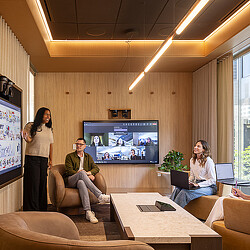
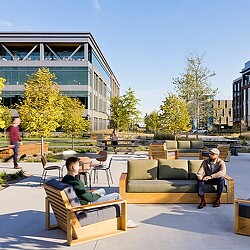
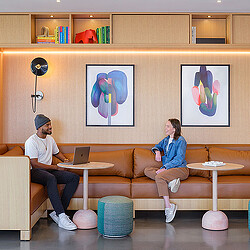
A New Value for the Workplace
in an Era of AI
As AI becomes embedded in daily work, the office becomes even more valuable as a place where knowledge, experimentation, and human insight converge.
Note: This is the third blog of a series unpacking the detailed findings of Gensler’s Global Workplace Survey 2026. Read part one here and part two here.
AI is reshaping work — but not in the way some headlines suggest. The workplace creates the conditions for people to learn, exchange ideas, build skills, and experiment together in ways no digital tool can replicate. As AI becomes more embedded in daily work, the office becomes even more valuable as a place where knowledge, experimentation, and human insight come together.
A recent Fast Company article, “How AI could kill the return to office,” raises the right questions: Which activities genuinely benefit from in-person collaboration? Where does mentorship thrive? What does the data actually tell us?
But the idea that AI makes the workplace obsolete misses a critical truth: how AI is adopted and how humans learn are fundamentally social.
We looked at data on AI and the physical workplace, and found the value of the office is unmistakable.
Learning-Oriented Employees Work and Use the Workplace Differently.
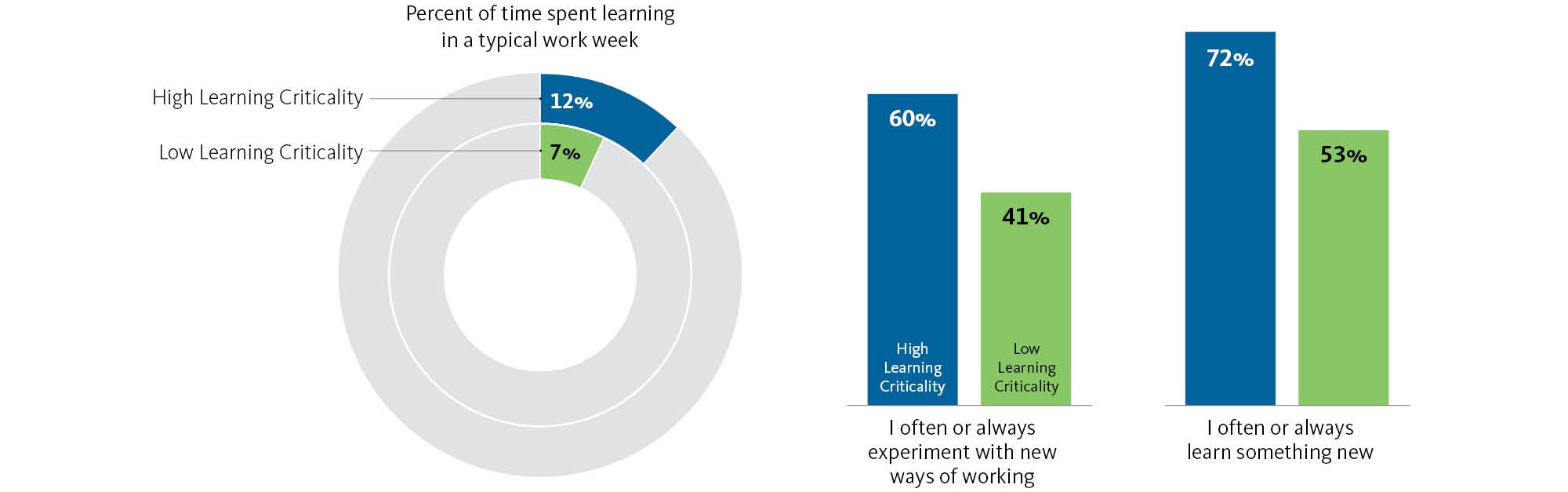
A significant majority (70%) of AI power users say learning is highly critical to their job performance, a signal of just how essential continuous skill-building has become. In Gensler’s Global Workplace Survey 2026, we found that workers who view learning as critical to their performance not only spend more time learning in a typical workweek, but they are also more likely to report that they often/always learn something new and experiment with new ways of working compared to those who do not perceive learning as critical to their performance.
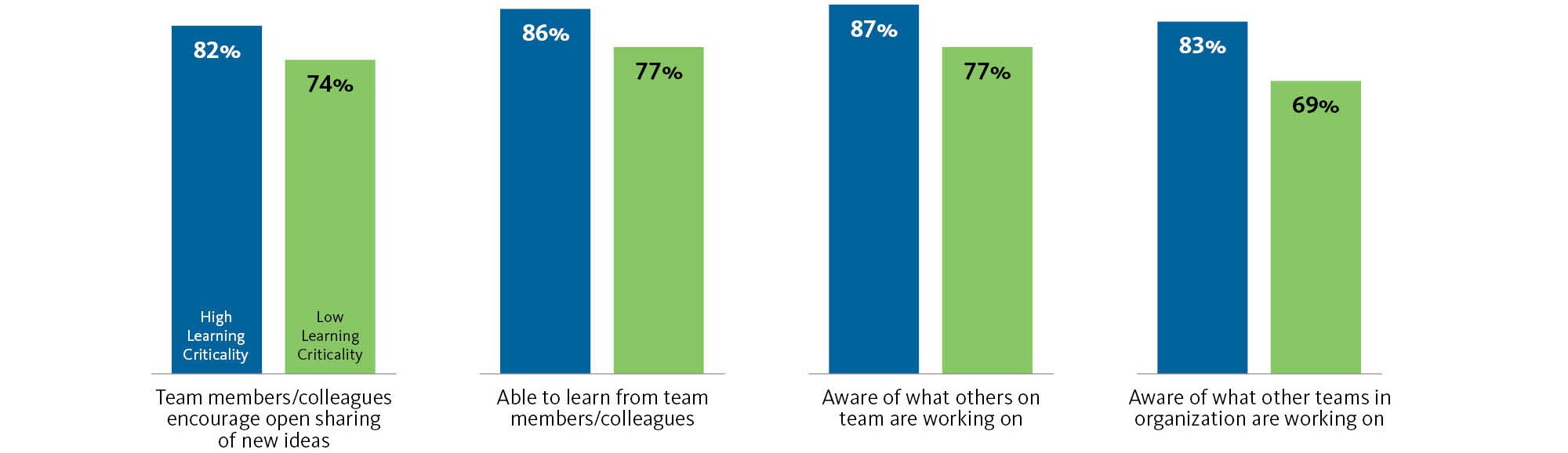
What’s more interesting is how learning is embedded into their day-to-day work. AI power users are more likely to be on teams that learn from one another. They share ideas openly. They stay aware of what others are working on, both in their team and across the organization. Learning happens in big and small ways — from picking up quick tips from coworkers, watching others, asking spontaneous questions, and sharing discoveries in real time. Learning isn’t a scheduled activity; it’s embedded in how we work throughout the day.
Why the Workplace Accelerates Learning
When employees are in the office, they’re surrounded by people and moments that accelerate their professional growth. A spontaneous conversation can unlock a better workflow. A glance at a teammate’s screen can reveal a new method. A quick chat after a meeting or over coffee can turn uncertainty into clarity. These micro-interactions can happen during a carefully orchestrated video call when teams are geographically dispersed, but they happen naturally when people share space.
For employees who perceive learning as critical, the workplace isn’t just a place to work. It’s where learning happens. It’s where ideas are tested, questions are answered, and breakthrough solutions emerge from everyday interactions. In an era defined by rapid technological change, that kind of environment becomes a real competitive advantage.
And the outcomes are clear. Employees who think learning is critical are more likely to say that working in the office positively impacts their relationships with colleagues, their awareness of critical intel, career advancement, the speed of decision-making, and the quality of their team’s work or services.

What Makes an Effective Workplace for Learning?
If learning is essential to job performance in an AI era, and our data says it is, then the workplace becomes a powerful enabler. Employees who rate their workplace highly on certain design elements also rate it more effective for learning.
Space attributes that matter most:
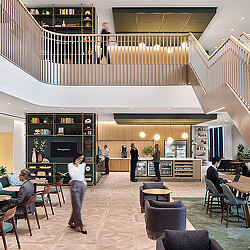
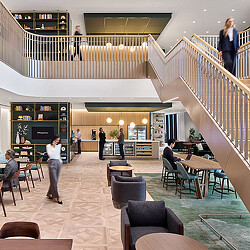
- Design look-and-feel — especially the workspace, open meeting areas, corridors/stairways
- Workspaces with managed noise levels
- Meeting areas with flexible, reconfigurable furniture
Experience attributes tied to learning:
- A beautiful office environment
- Office equipped with the latest technology
- Easy to access spaces to relax/recharge
- Easy to access spaces for focused concentration
These attributes contribute to the conditions that support rapid skill development, peer-to-peer learning, and experimentation — all of which become more crucial as AI adoption accelerates.
Workplaces Must Support Both Learning and Connecting
The most successful organizations will be those that intentionally foster learning, connection, and professional growth in their workplaces. AI adoption is happening in real time, and formal training programs can’t keep pace. What shapes new technology habits is informal, in-the-moment learning — the kind that rarely happens over Zoom.
That means creating:
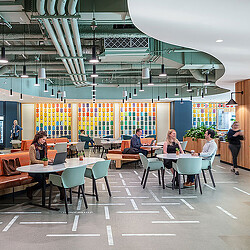
- Spaces for small gatherings
- Environments that spark informal conversations
- Settings that encourage interpersonal connections and new forms of collaboration
- Opportunities for mentorship, coaching, and spontaneous knowledge-sharing
- A variety of spaces, from large communal zones to intimate 1:1 settings, where teams can build trust and experiment together
AI may automate tasks, but it cannot replace the social and developmental ecosystem that occurs when people come together with a shared purpose.
The Bottom Line: AI Elevates the Importance of the Workplace
AI isn’t killing the return-to-office. It’s revealing its true value. We are entering an era where skills constantly evolve, roles are retooled, and work processes change rapidly. Real innovation occurs when people with diverse skills and perspectives come together. And that makes the physical workplace a strategic investment in human potential. It’s where learning accelerates, relationships deepen, and new ideas take hold.
As organizations navigate the next chapter, they should ask: “What kind of workplace will help our employees thrive in an AI-powered world?”
And the data gives us the answer: A workplace that is beautifully designed, technologically equipped, flexible, and deeply human.
For media inquiries, email .