The Opportunity Hidden in Downtown San Jose’s Experience Gap
New City Pulse data reveals a sharper opportunity for San Jose: close the gap between downtown’s civic importance and the way people experience it today.
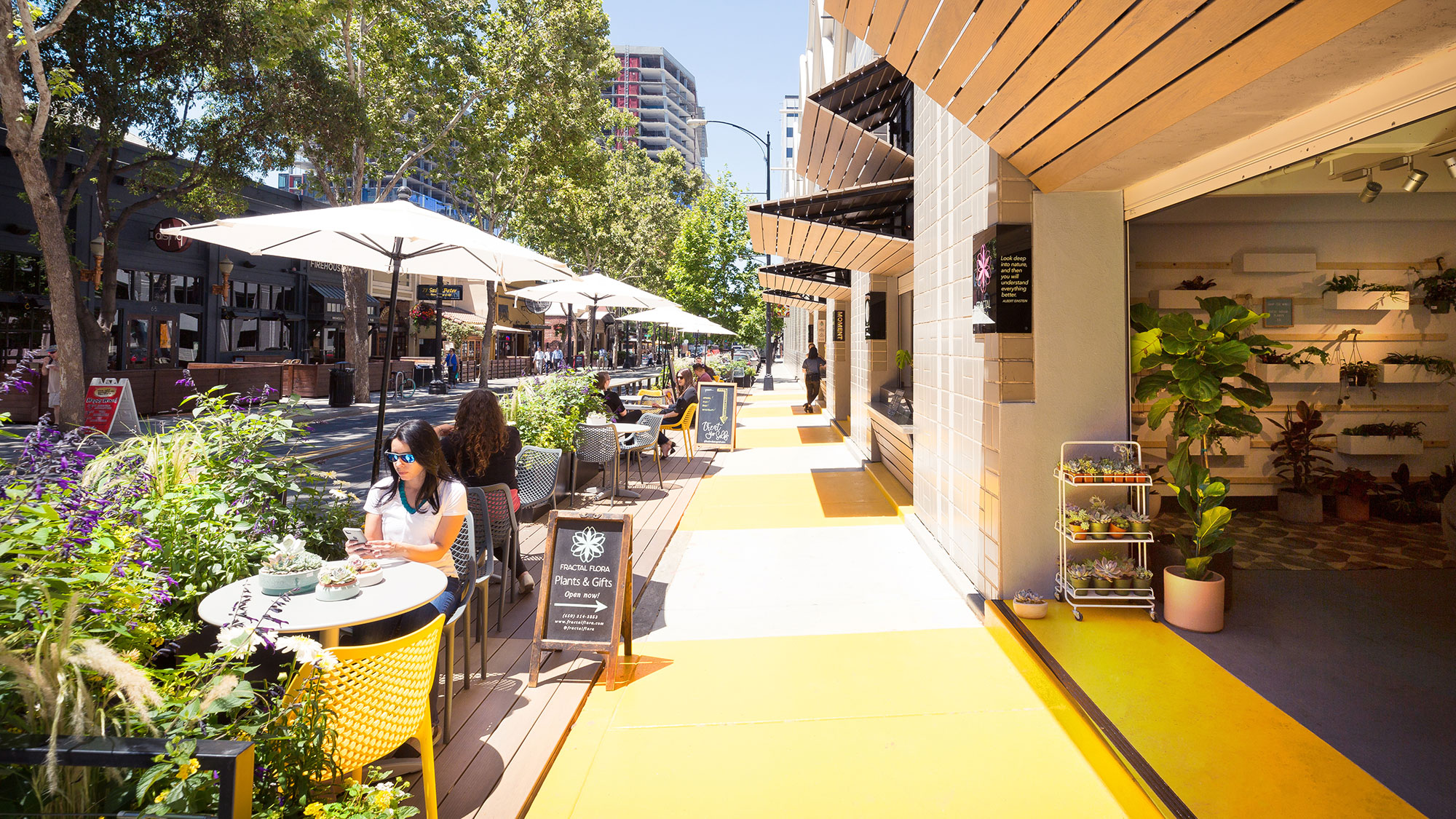
The workday ends. Students move through Paseo de San Antonio. A show lets out near the theaters. Dinner starts in San Pedro Square. A Sharks game pulls people toward SAP Center. The pieces of Downtown San Jose are all there. The question is whether those pieces add up to a place people choose, again and again.
Gensler’s new City Pulse 2026 research points to a clear opportunity for San Jose: Downtown has the ingredients of a more magnetic urban center, but the data is also blunt. Residents do not yet experience those ingredients as a coherent, memorable, or iconic downtown. The opportunity is to close the gap between San Jose’s civic and economic importance and the everyday experience of its urban core.
The Foundation: Assets Without a Fully Legible Experience
In the City Pulse research, 60% of respondents familiar with Downtown San Jose agree that the business district offers a great experience. Nearly two-thirds say it feels enjoyable to walk around and welcoming to everyone. More than half describe it as authentic, memorable, and vibrant. Those findings matter, but the broader ranking data make clear that positive local sentiment is not translating into a competitive downtown experience.
For city leaders and developers: start with what is real. Downtown San Jose has a genuine food scene, established cultural institutions, a major university presence, a civic core, and a year-round calendar of sports, festivals, and arts programming.
The fragments of a great downtown are already on the ground. San Pedro Square, SoFA, Little Italy, Paseo de San Antonio, San Jose State, the Convention Center, SAP Center, MOMENT, the theaters, museums, restaurants, and an emerging residential base can function as a network. The raw material exists. The synthesis does not yet.
When Downtown San Jose is compared with 33 other U.S. downtowns in the City Pulse dataset, the experience gap becomes harder to ignore. San Jose ranks at the bottom of the peer set across the seven character and experience attributes, with the lowest ratings for being perceived as iconic, beautiful, memorable, and authentic. Downtown’s value is real; it’s just not yet legible, connected, or consistently felt by the people experiencing it.
The Gap: Potential, Perception, and Habit
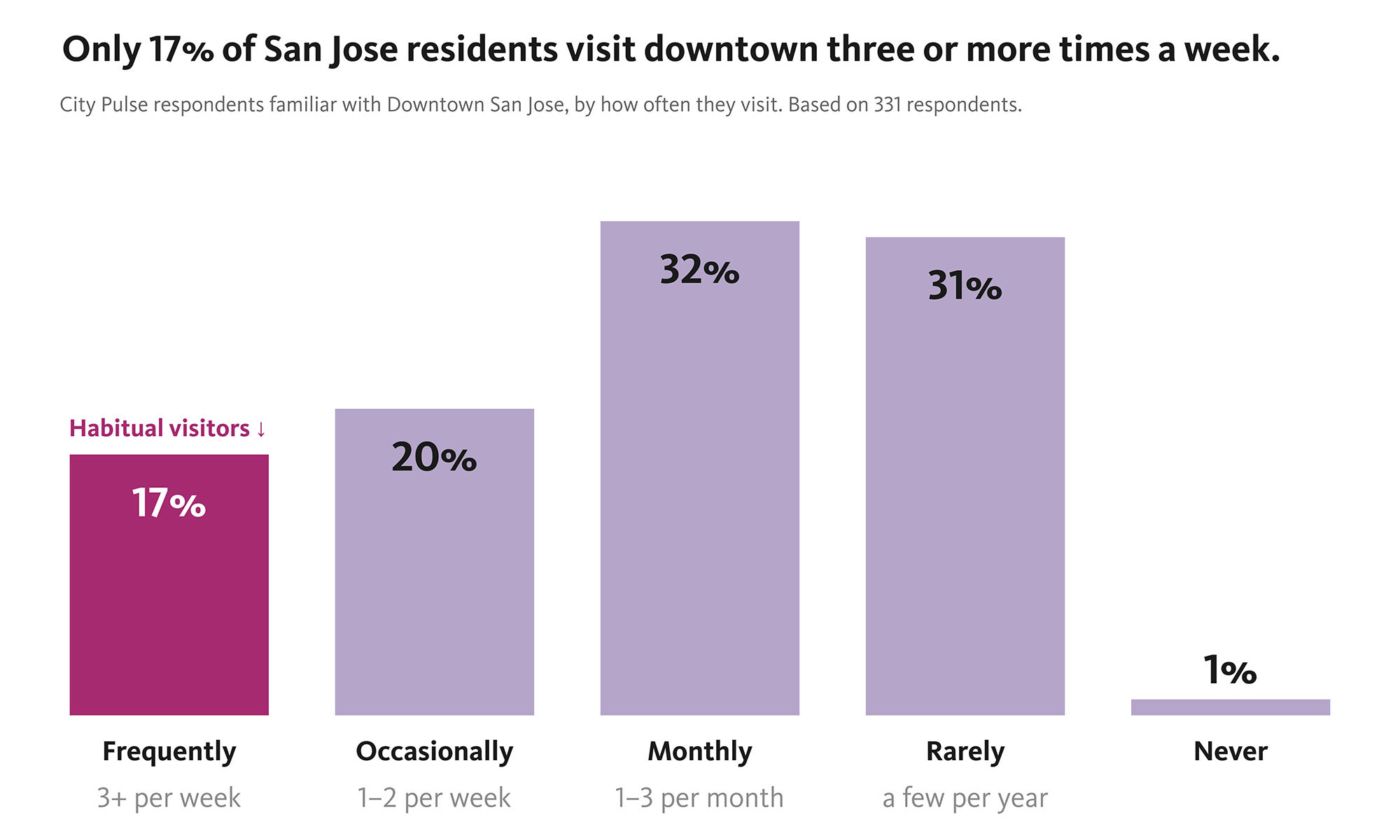
That perception gap shows up in behavior. Only 17% of respondents say they go downtown three or more times per week. Another 32% visit just one to three times per month, and 31% go only a few times a year. When people do visit, many are transactional. Thirty-seven percent say they usually do what they need to do downtown, then leave a little while later. Another 29% say they only go when absolutely necessary.
Today, too many visitors experience downtown as a set of isolated destinations rather than a continuous urban experience. People come for a specific reason, complete it, and leave. The district works as a series of errands. It does not yet work as a place to linger.
The real opportunity is continuity and legibility: a downtown that people can understand, remember, and return to between the big moments.
The Path: From Peak Moments to Everyday Momentum
When residents were asked what would make Downtown San Jose more attractive, the top answer was not office space. It was not coworking. It was not a single major project. It was community life.
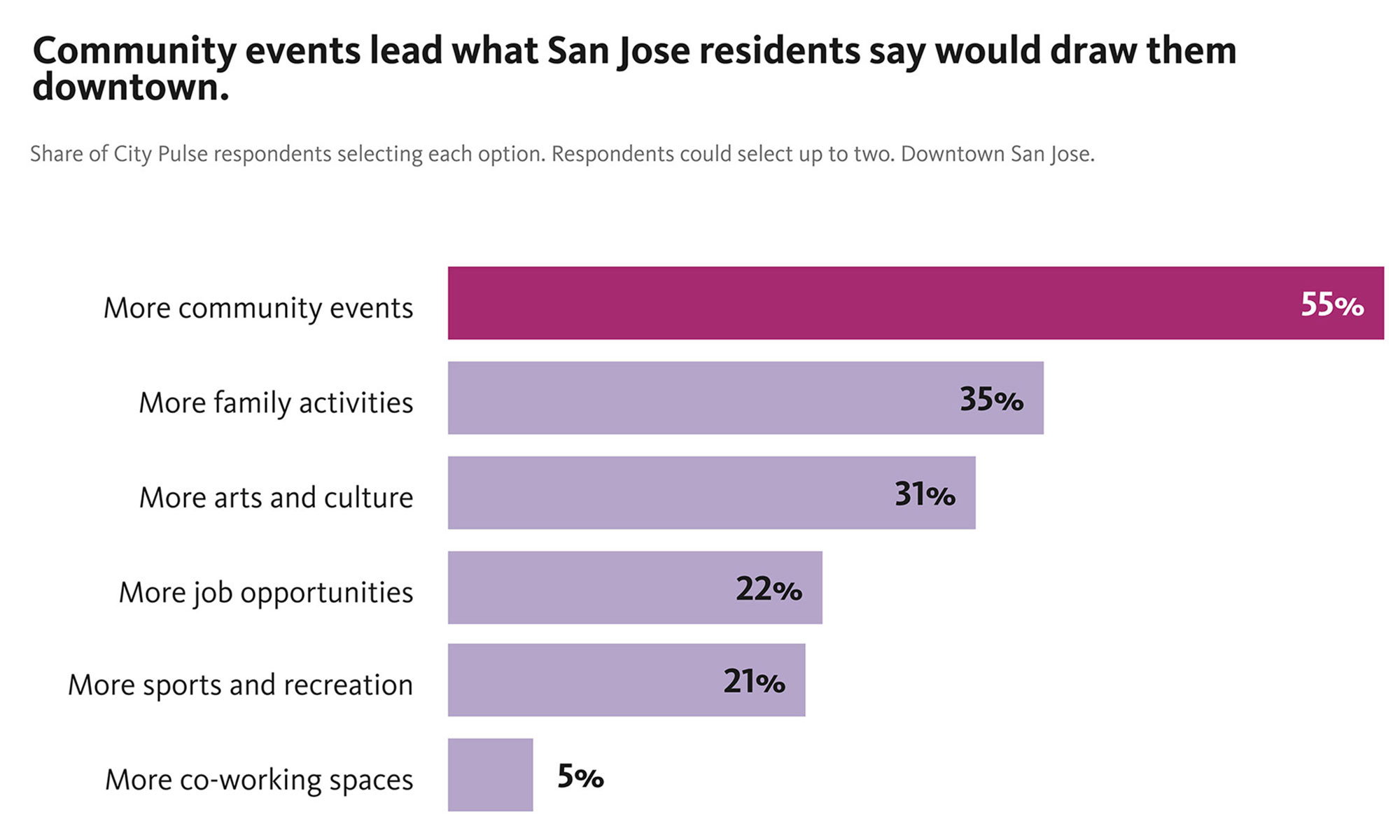
Fifty-five percent selected more community events, including festivals, markets, parades, and open streets. Thirty-five percent selected more places and activities for families. Thirty-one percent selected more arts and cultural programming. On the business side, respondents prioritized more independent shops and cafes, grocery and essential retail, better restaurants, nightlife and entertainment, and outdoor dining.
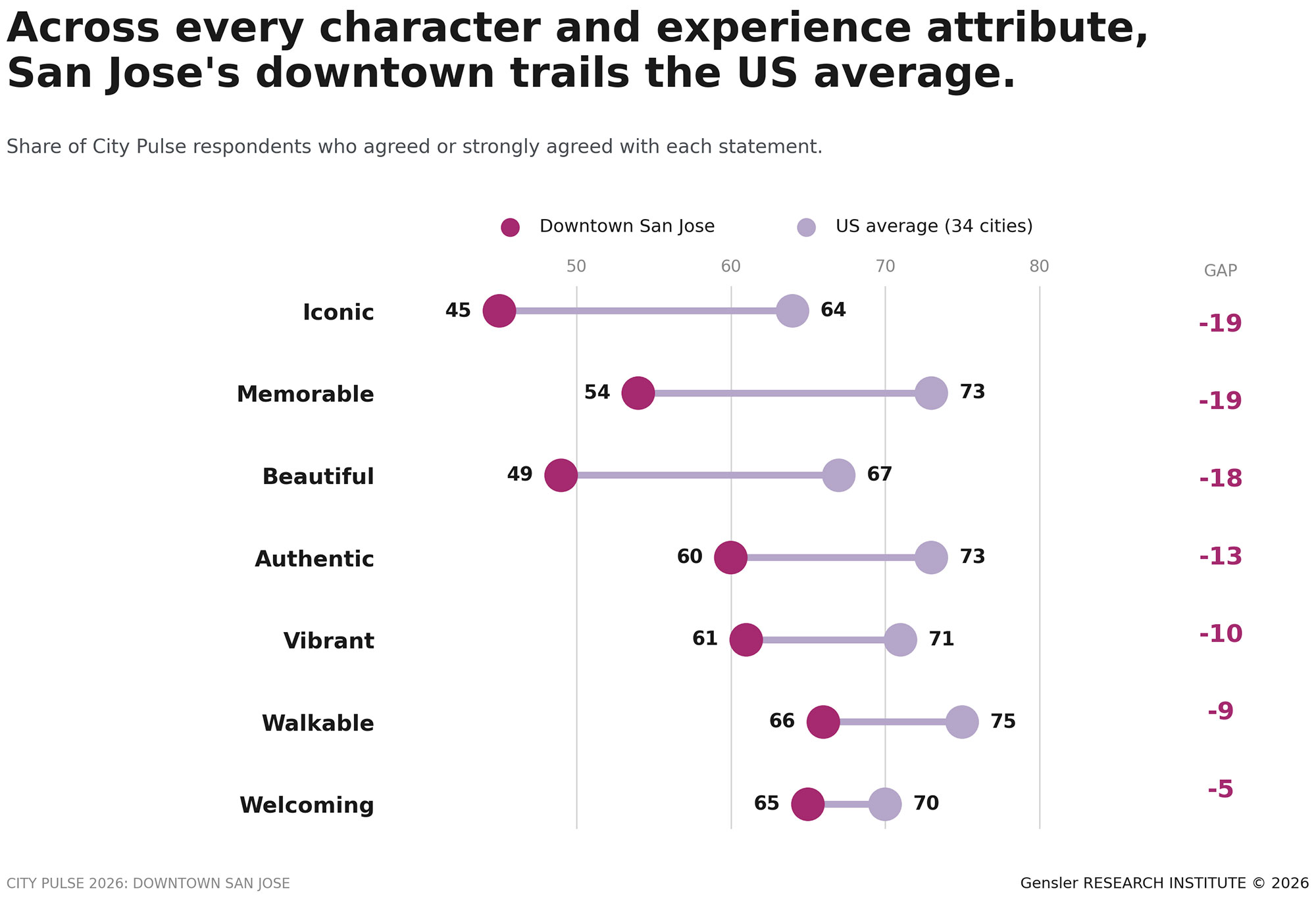
This is where San Jose still has a real advantage. The city does not need to import an identity. It needs to make its existing identity more visible, connected, and repeatable in downtown daily life. Programming matters, but San Jose trails most in being iconic, beautiful, memorable, and authentic qualities that require a distinctive public realm and signature places people can picture even when they are not there.
But magnetism is not only about programming. When asked what is most important for a thriving downtown in the future, 57% of respondents selected safe, clean, and well-maintained public spaces. That was the top answer by a wide margin. Street-level improvements tell the same story: more safety from crime, cleaner public spaces, more places to sit, gather, and relax, and public restrooms ranked highest.
The data also surfaces a specific design challenge. Women rate their city’s safety significantly lower than men across nearly every measure, including a 19 percentage point gap in feeling safe walking alone at night. This pattern appears in cities globally, but it carries a clear instruction for San Jose. A district that does not feel safe and welcoming to women, families, and older adults will struggle to build the everyday foot traffic that makes downtown magnetic.
Much of what makes a street feel unsafe is structural. Vacant lots and empty storefronts create blank, inactive frontage, and a block with nothing happening on the ground floor feels exposed, no matter how well-lit it is. Occupied, active edges do the opposite: they put people and sightlines on the street throughout the day. This is why ground-floor activation, lighting, sightlines, and places to sit are equity fundamentals.
When respondents imagined Downtown San Jose 10 years from now, the leading vision was a lively mixed-use district with housing, shops, and offices, followed closely by a cultural and entertainment destination. Downtown San Jose should not have to choose between being a neighborhood, an entertainment district, an employment center, a university district, or a civic heart. It can become all of those things when intentionally connected.
Places like The Battery Atlanta show what happens when sports, entertainment, housing, retail, and public space are planned as a daily district rather than an event-day machine. The lesson for San Jose is to ensure major venues strengthen the everyday downtown around them.
The clearest message from the San Jose data is also the most actionable: residents are asking for a downtown that is safer, cleaner, more social, more local, more walkable, more family-friendly, and more useful in daily life. The low ranking is not a verdict on San Jose’s potential. It is a mandate to make that potential visible, connected, and usable.
Downtown San Jose’s next phase should be measured less by how many people arrive for a single event, and more by how many choose to stay, wander, return, and make downtown part of their routine. That is the work ahead: connect the assets, raise the quality of the public realm, support local businesses, strengthen the district’s identity, and turn episodic activity into everyday urban life.
Downtown San Jose does not need to become another city’s version of success. Its opportunity is to become a more coherent, more magnetic version of itself. The harder question is how a city without a redevelopment agency pays for any of this. That is where we go next.

For media inquiries, email .