October 07, 2026
Gensler’s Latest Research With ROAR and Oxford Economics Finds Public Space Around Stadiums Is Where Crowds Become Communities
A three-part study of the 2026 FIFA World Cup finds fans used collective language 70% more often when posting from the plazas and streets outside stadiums, underscoring the opportunity design has to foster collective effervescence.
SAN FRANCISCO — World Cup fans used collective language such as “we,” “our” and “us” 70% more often when posting from the public spaces around stadiums than from inside them, according to The Fandom Effect: Sports Urbanism 2026, a new three-part study released today from the Gensler Research Institute, ROAR, a Seregh Company, and Oxford Economics. The study sought to establish a baseline understanding of how people engage with sports venues in their area, use the 2026 FIFA World Cup to understand the fan experience journey during the tournament and measure the impact post-tournament across 16 host cities.
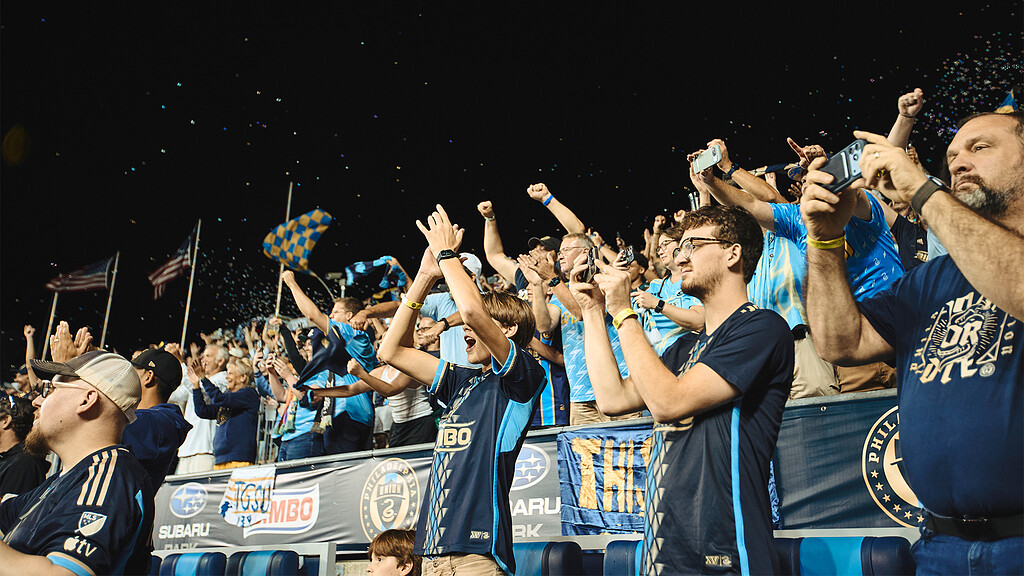
When fans’ posts included words associated with awe, such as “goosebumps,” “unreal” and “electric,” their use of collective language rose by 189%. The findings suggest that the awe-inspiring spaces around a venue, not just the venue itself, are where crowds transform into communities.
The report lands as sports-anchored mixed-use districts (SMDs) are expected to attract more than USD$100B in investment globally over the next 15 years. The research builds on three sources:
- A baseline survey of 5,858 adults across 17 cities in the U.S. and Canada, conducted in partnership with Oxford Economics in April 2026
- A social listening study tied to every host stadium that filtered and analyzed hundreds of thousands of fan posts specific to the fan experience in real time in partnership with data analysis partner ROAR, a Seregh Company
- A post-tournament sentiment survey of host-city residents conducted by the Gensler Research Institute
“The stadium is where people watch the game, but it’s the space around it where fans told us they feel like they become part of something,” said Lauren Adams, Global Director of Lifestyle Research at Gensler. “If we don’t design that space with the same intentionality as the bowl, we’re passing up the opportunity to maximize the most valuable part of the experience.”
Key findings from the research also reveal:
Friction Starts Before Fans Reach Their Seats
Arrival, entry, and ticketing were the only consistently negative themes that emerged from our social listening study. They were also the one stage of the fan journey where language associated with awe was almost entirely absent. Once inside, 80% said it was easy to view the action from their seats.
The research identifies the entry sequence as the lowest-risk, highest-return place to invest in design, both for major events and for everyday use.
“Using ROAR’s cutting edge, proprietary AI technology to examine massive amounts of organic fan conversation across multiple platforms before, during, and after games enabled Gensler and ROAR to generate tangible insights into fans’ in-venue and district experiences,” said Adam Grossman, President at ROAR, A Seregh Company. “Taking proactive steps in the design process and during the game-day experience to directly mitigate traffic and ingress issues would enable the substantial positive attributes of attending sporting events to resonate more clearly with fans.”
Outside of a Global Event, Districts Fall Short
The baseline survey conducted prior to the World Cup, showed that the areas around venues are not yet delivering the same experience as the venues themselves. On average across the 73 venues and their districts, 87% of respondents who recently visited rated the venue experience positively, compared with 69% of respondents for the surrounding district. An average of 90% would recommend the venue, compared with 71% for the district.
Safety and family offerings account for much of that gap. 69% ranked safety among the top three qualities of a good sports district. 57% said nearby family activities would make them more likely to buy a ticket, yet only 39% found such activities around the venue they most recently visited.
Interest in these districts goes well beyond game day. Nine in 10 respondents are open to visiting on a non-event day. Food festivals (42%), seasonal or holiday events (37%) and farmers markets (34%) topped the list of draws.
People who live or work near a venue are already the most engaged: 84% seek out events at specific venues because of their attachment to the surrounding area, compared with 56% of non-locals.
Better Events Start with Better Cities
Host-city residents drew a clear line between event-day operations and everyday city life. For future events, respondents to the post-World Cup survey want cities to prioritize traffic management (41%) and safe public areas (39%). Over the long term, they want more reliable public transit (42%), cleaner and better-maintained public spaces (41%), and investment across neighborhoods rather than only in event areas (38%).
The report outlines five steps for turning sports districts into year-round civic spaces:
- Improve access and perceptions of safety
- Deepen the offer for locals
- Add low- or no-cost attractions
- Zone the mix of uses to welcome different audiences
- Program festivals and seasonal events that create the same sense of shared experience as game day
About Gensler
At Gensler, the value of our work stems from its positive impact on the human experience. We are a dynamic and collaborative design firm uniting creativity, research, and innovation to solve complex problems for our clients. Our work challenges conventional ideas about architecture and the built environment. We aren’t just designing buildings — we are reimagining cities and places that make a difference in people’s lives. Founded in 1965, Gensler has built a team of 6,000 professionals who partner with clients in over 100 countries each year. Everything we do is guided by our mission: to create a better world through the power of design.
About the Gensler Research Institute
The Gensler Research Institute is a collaborative network of researchers focused on a common goal: to generate new knowledge and develop a deeper understanding of the connection between design, business, and the human experience. Through a combination of global and local research grants, and external partnerships, we seek insights focused on solving the world’s most pressing challenges. We are committed to unlocking new solutions and strategies that will define the future of design.
About ROAR, a Seregh Company
ROAR delivers purpose-built, AI-native solutions at the intersection of sports, real estate, and revenue. ROAR Intelligence enables sports properties, rights holders, agencies, and corporate partners to drive incremental growth across assets and revenue streams. It also serves as a data-driven engine for conceptualizing, developing, financing, and monetizing sports- and entertainment-anchored real estate districts. ROAR is part of Seregh, the only institutional platform dedicated to global sports and entertainment, real estate development and investment.
Media Contact:
Sara Munday
Global Director, Public Relations
For any media inquiries, please email .
