The Inventive Workplace: Designing the Office as a Place to Generate Great Ideas
As AI streamlines routine tasks, the most valuable work happens between people. Here’s how to design workplaces that make ideas move.
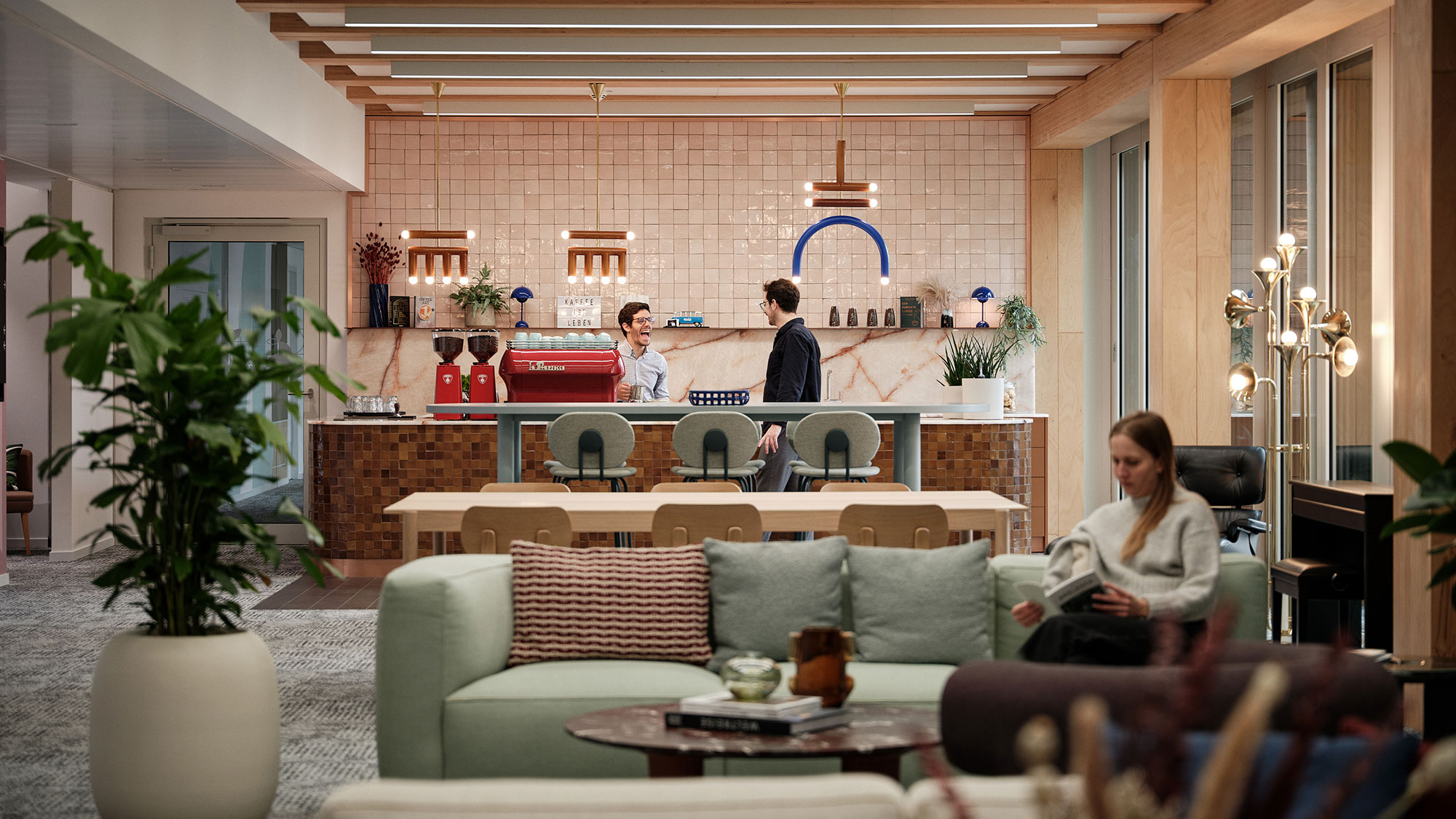
Here’s a riddle: What’s something that when you give it away, you end up having more?
AI can now solve riddles like this one in seconds, and draft and analyse just as fast. What remains scarce is original ideas and the judgment to choose among them.
Many of my clients in the technology and creative sectors already measure their success by their ability to come up with new solutions to problems and puzzles that are more complex than any riddle. So where does this innovation actually happen? How do we design workplaces where people have better ideas than they would anywhere else?
Researchers such as Carrie Elkins and Frances Frei suggest that invention flourishes when ideas move. Two half-ideas become a whole idea, and one whole idea can find new applications and audiences. Over time, that exchange builds a culture that inspires great ideas, one after another. To design a place where we can generate great ideas, we must design for exchange.
Inspired by theorist James Thompson, we can imagine three different ways teams share information and tasks: Pooled, Sequential, and Reciprocal.
Pooled: Space for Solo Insight
The first is “Pooled.” It works like a gymnastics team, where individual performance is added together to create a collective outcome. When the whole is the sum of smaller parts, the scoreboard is critical — a constant reminder of the larger goal and how each effort contributes to achieving it.
When tasks are pooled, invention is a matter of optimising individual ideas. According to Marcus Raichle of Washington University, the “lightbulb moments” we need to solve riddles and crossword puzzles are more likely to occur when our brains are in Default Mode, the state we enter when we are resting or performing habitual tasks. This is why some of your “Aha” moments come when showering, or walking the dog, or when you’re about to fall asleep.
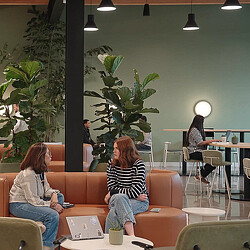
To design for default mode, we need to create spaces where our brains are moderately engaged, not focused or agitated. Examples include analogue rooms, game rooms, outdoor areas, and even showers.
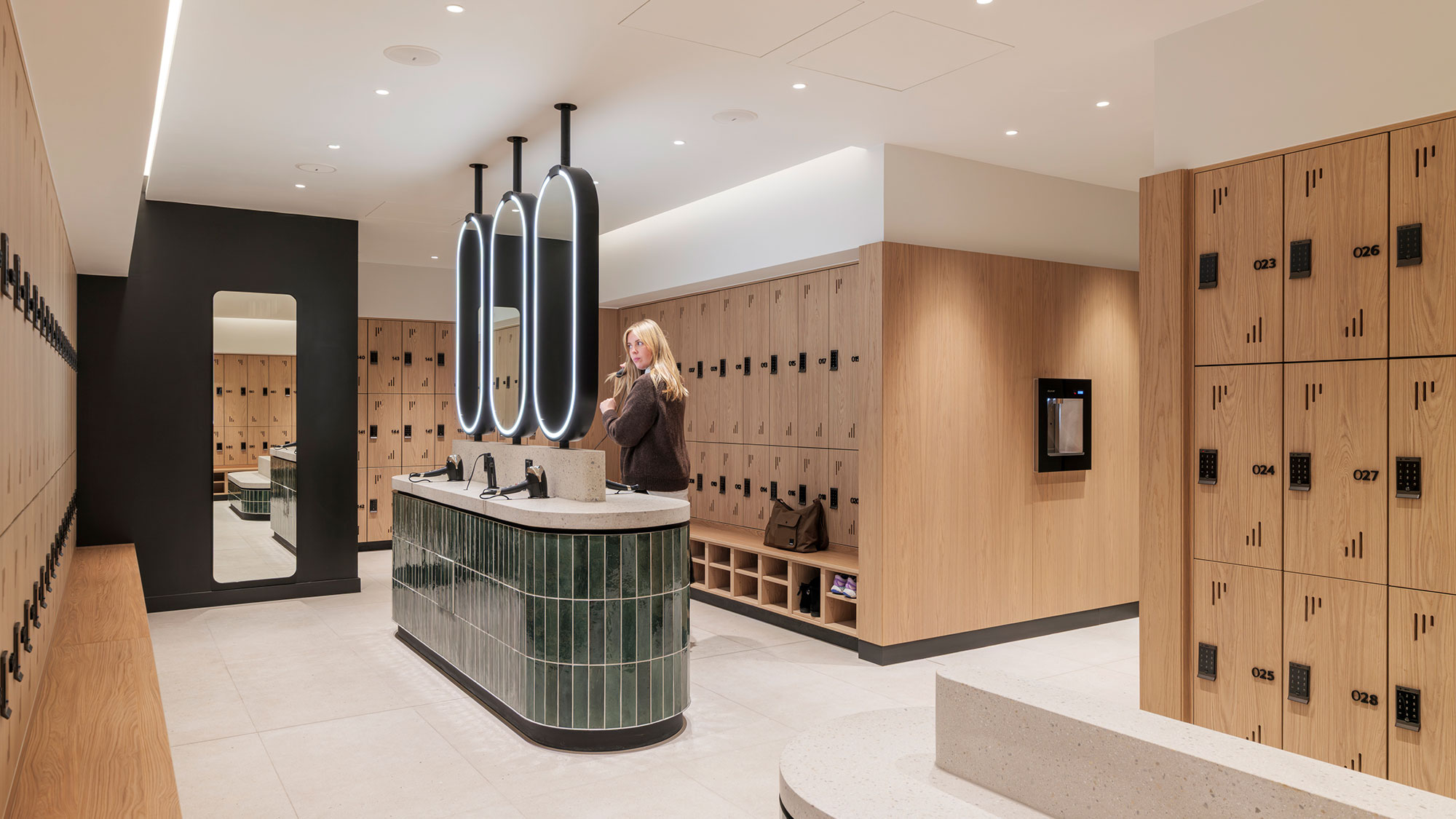
Gensler’s Global Workplace Survey 2024, found a correlation between access to default mode spaces and high performance: high-performing workplaces are 3.8x more likely to offer spaces to relax and recharge, and their people are 54 to 70% more likely to take time to reflect, be outside, and unplug from technology.
Sequential: Make Ideas Contagious
The second mode works like a relay race: information passes sequentially from one individual or team to the next. Individual performance matters, but the handoff from one idea to the next is what differentiates a good idea from a great one. This handover is called Knowledge Spillover: the goal is to showcase half-formed ideas and unsolved problems that might light a spark for someone else, making an idea contagious.
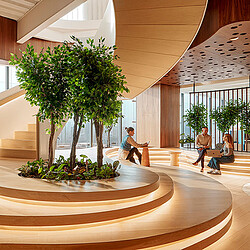
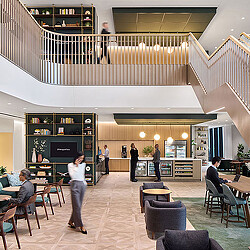
Gensler’s Global Workplace Survey 2026 shows how this manifests in the workplace: the design of corridors and stairways ranks amongst the top five attributes linked to learning. These are places where knowledge is exchanged across weak ties between one team and the next. Our clients are investing in their interstitial spaces, making them interactive spaces where people will stop and chat with colleagues from other groups and teams.
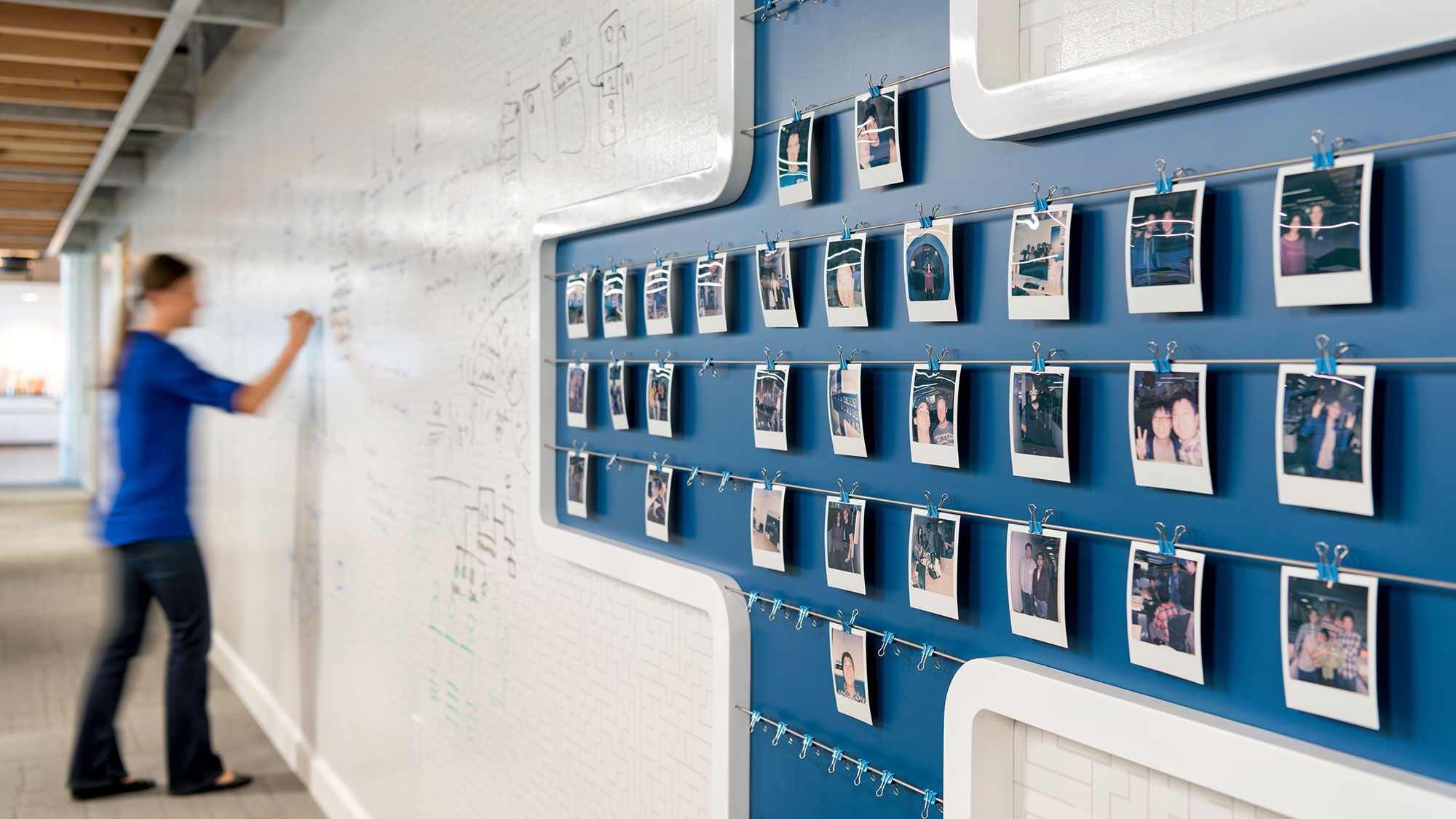
Our workplace research also indicates a correlation between spaces for sequential exchange and high-performing workplaces. In high-performing workplaces, team members are 87% more likely to be aware of what their teammates are working on and 3.6x more likely to be inspired by new thinking, according to our 2025 survey.
Reciprocal: Build for Real-Time Play
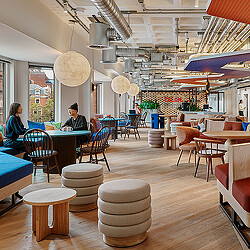
The third mode, which Thompson called “Reciprocal,” works like a football team. The players interact constantly and dynamically, in real time. This requires an environment that allows players to adjust and recalibrate as play proceeds.
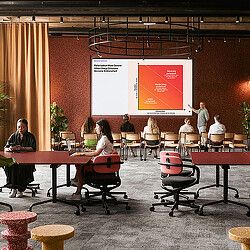
Many of our projects for technology and creative clients anticipate this dynamic environment. At Celonis’ Munich office, incubator labs for live workshops, demos, and software application testing allow employees to reconfigure their space as their work evolves.
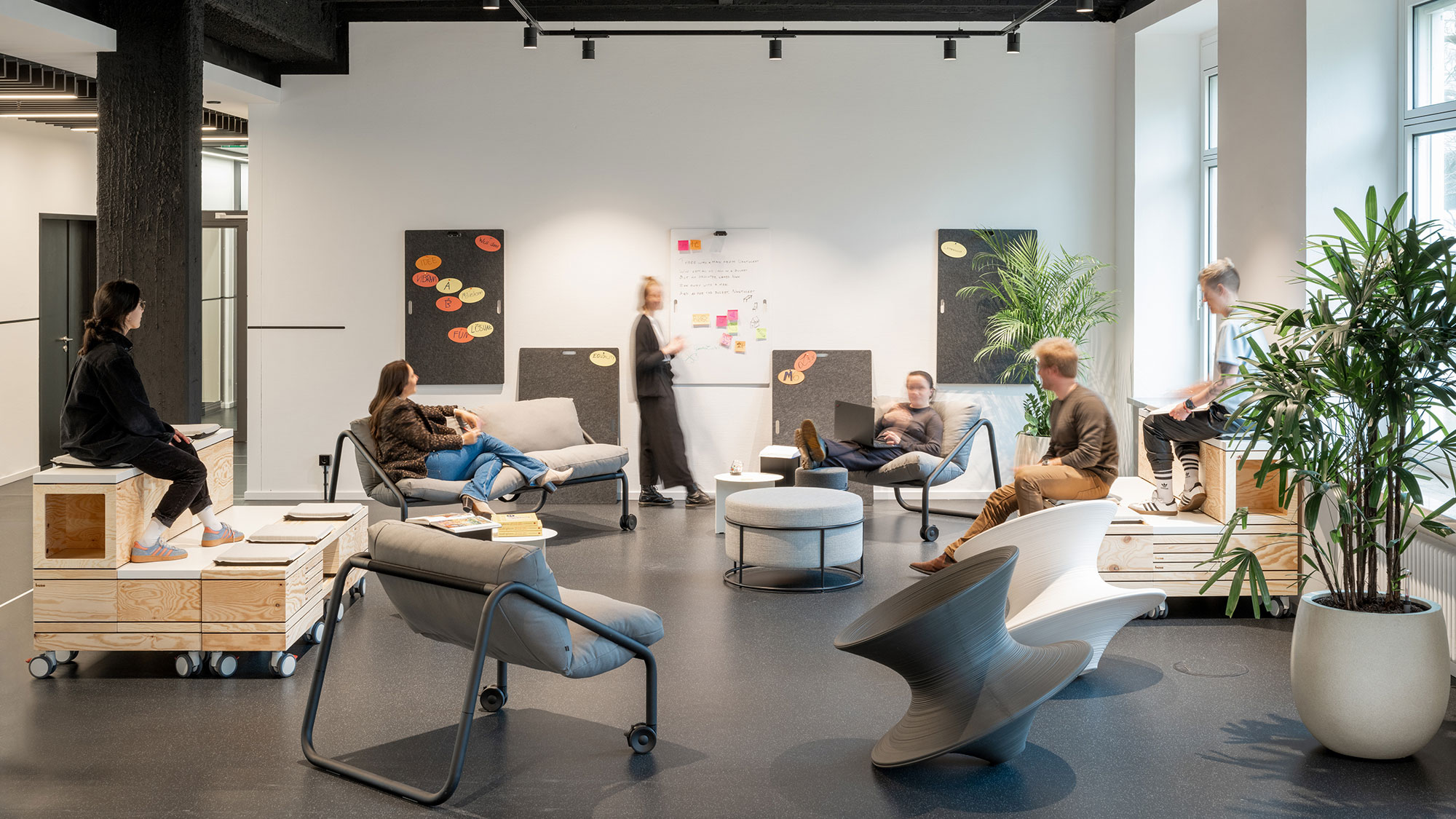
The ability to rearrange furniture ranks amongst the top three space factors linked to knowledge exchange, according to Gensler’s Global Workplace Survey 2026.
Reconfigurability still depends on thoughtful design. Our Global Workplace Survey found that high-performing workplaces are 2.6x more likely to have impromptu meetings with colleagues, 3.2x more likely to work in a variety of spaces, and 4.9x more likely to experiment with new ways of working.
What AI Changes
AI excels at Pooled exchange, conducting multiple parallel tasks, and it’s rapidly improving at Sequential exchange, running full workflows from beginning to end. As a result, human work is shifting towards Reciprocal exchange.
According to Atlassian’s research of 12,000 knowledge workers, “AI [is] compressing execution and shifting the constraint to judgment, alignment, and decision-making.” This makes the work that happens between people more critical than ever.
Our Global Workplace Survey confirms this. AI power users spend less time working alone and more time learning and socializing, which they consider critical components of their job performance.
If AI is making human work more reciprocal, we must design spaces for dynamic exchange. We tend to prioritise “core” work areas, but we must focus on the spaces in between the programmatic elements, because this is where idea exchange happens.
Think of the Vienna Sausage Company in Chicago. In their old factory, a man named Irving carried the uncooked sausages through a maze of passageways, through the boiler room, and past the tanks where the beef was cooked to get to the smokehouse. Then in the 1970s, they modernised the plant and optimised the whole process by putting the sausage packing room right next to the smokehouse. But the sausages from the new plant fell short. Irving’s meandering journey was actually their secret recipe: by optimising their workflows, they engineered out what made them unique. The same holds for the workplace. The corridors, stairways, and winding routes between rooms are often where the best ideas take shape.
So, what’s something that when you give it away, you end up having more? It’s an idea.
For media inquiries, email .